This is the second part of the my summary on Frits Staal's book - "Discovering the Vedas". The first part of the summary is here. The first part basically focused on the origin of early Vedic speakers and the time and space in which the Vedas were written. This one is brief gist on Vedas and their context. As with the first part, the summary below is what I have read in the book and I am no Vedic culture expert to deny or confirm any of the ideas that the book puts forward.
By the end of first part we had come to a conclusion that early Vedic settlers came from somewhere in Russian steppes, made a long and arduous journey taking along with them their Indo-European language, myths, fire worship, soma practice and knowledge of horse and chariots. They initially settled in NW India around 1800 BC slowly moving east into the Gangetic plains. The culture was primarily village based, male dominated and ritual driven. It could have been that women (for marriage) would have come from the indigenous population and early Vedic settlers married into indigenous tribes to advance their clan or family's political/societal aims. These indigenous population contributed greatly like the name of tribes which later became the name of Vedic schools (sakhas). Women are not mentioned frequently in early Vedic text. We hear very little about women or their state. There is specifically no mention in Vedas of what was to be later known as "dependence of women" that states that a women's dependence is first on her father, then on her husband and lastly on her sons. This idea was codified much later in the 2nd century AD in the manu-smriti from where is widely took life of its own and could be said to be a seminal event in relatively poor state of women's status in Indian society. Similarly caste began appearing in the later Vedic works and in the post-Vedic dharamsutras and by the time of manu-smriti in 2nd century AD, it was also codified. Though the widely prevailing view is that caste was inherent to Vedic society probably because it fits into the aryan invasion theory whereby the invaders became the higher caste and indigenous tribes the lower status groups. But since in the first part summary, we have concluded that there was no invasion, instead a smaller group of settlers crossed over. The genetic material also goes back 9000 years making the idea that Vedic speakers could fashion a new social order so quickly is far fetched. The idea of attribute caste to Vedic civilization is either to make them easy scapegoat or to make the concept as being divine and foretold by Gods. Rig Veda (RV) mentions broad classes like árya and dása. Possibly árya could have been Vedic settlers and indigenous tribes being dása. But Vedas does mentions something very similar to the current social order. It states in the below lines [bráhman, ksatram, viš] which could relate more to the realm of occupation that groups of people are engaged in rather than a strict societal order. These lines are from RV -
promote the bráhman (language) and promote poetic inspiration,
promote the ksatram (power or dominion) and promote able bodies men
promote the viš (the common people) and promote cows.
These words were to later become brahmin, ksatriya and vaishya which now are the three higher castes (varna). Note that there are only 3 words mentioned[bráhman, ksatram, viš] and RV does not clearly state what could these words mean or if they actually meant social order. Multiple references in later works display no fixed social hierarchy and it looks like order did not matter initially and sometimes these words have no settled meaning or the meaning seems to shift. Also in the Vedas itself, there are references of a united front of brahman-ksatriya against vaishya who may have been indigenous. bráhman was still a flexible term and does not seem to occupy a fixed place in rigid system of classes or caste. That hardening happened much later. In early Vedic sense, varna could have referred to the state of a person like being royalty or learned. RV has no word for social classes but has a word 'varna' which meant color and this word is mentioned only once in RV, on the other hand jati (birth) was not even mentioned in Vedas. In RV's famous purusha sukta,[10.90] is the only place where a four layer social order is mentioned. In this hymn, purusha is a primordial man that is being sacrificed and it assigns the four varnas - brahman, rajanya, vaishya and sudra to his mouth, arm, thighs and feet. This is the only place where four layers social order instead of three are used and most linguistics and scholars agree that this sukta(hymn) is a late addition to RV as it does not resemble any other RV myth (in form and diction) and is not in accordance to early Vedic social distinction. Most likely it was added later in RV to give weight and justify the new social order. So what originally started as an order to classify people into árya and dása groups later became three layered (middle Vedic) and then four layered (later Vedic) and then to a complex conundrum of varna and jati (British age) by cooperating priests-royalty combine.
The book also broadly touches on the Vedas and their context. There are 4 Vedas and each Vedas has four different layers. The core is the samhitas which are verses and mantras, mostly in praise of Gods. The next layer is aranyakas (which literally mean 'produced in forest'). This layer mainly deals with ritual (maybe rituals in the forest as possibly forest are seen as a mysterious place where mantra and ideas originate). The next layer is brahmana which are broad commentaries on many topics. The last layer is called upanishads which is a open category and deals with philosophy and spiritual ideas. The Vedas are not one piece and never composed as one piece. They have constantly evolved over the times. The chief division of Vedas is sakhas(school) from where they
originated. Each school goes
back to a clan or tribe in a particular area and each sakha would memorize a specific Veda (and all it layers). The Vedic text itself of these sakhas would be slightly different from other schools of same Veda but the difference is minor. Most of these text of these schools have now been lost, but still some survive. In a settled village based Vedic civilization, cattle and cow was the primary means of wealth. Society transformed from a nomadic lifestyle to a village based. Spoke chariot building were specialized skills and the builders had a high place in society. They were called rathakára. RV does not mention them, but taittiriya brahmana states rathakára in line with other three castes. It looks as if the three caste did not have the same meaning in RV as in
post Vedic works, rathakára occupied high status in
Vedic times before the actual codified caste came into being where it got lost. RV was composed in upper Indus valley and the other three in upper (kuru/pancala) and middle
(kosala/videha) courses of the Ganges. In midst of this geographical migration towards east, there is an evolution in Vedic Sanskrit thought and culture besides language. (Early, Middle and late
Vedic)
Rig Veda [RV] is the oldest and mostly composed in Indus valley area [Early Vedic period, 1800 - 1200 BC] mostly by clans. The importance of some Gods seem to change within the Vedas itself and some ideas of early RV were discarded by the time the other Vedas were composed. In this sense, we can say the RV was probably most alien with ideas and discourse closer to nomadic culture than to the settled cultures of later Vedas. In RV, there are 12 invocations of varuna, 23 invocations for varuna-mitra, mitra is not only a friend but personification of contract (he is something similar to mithra of iranian religions). These deities have a much smaller cult compared to indra who pervades the RV. In later works, mitra no longer appears. Most likely mitra was part of old folklore of nomads wandering around Asia as mitra is present in Iranian and Mittani religions as well and was discarded later on. Also present in RV is the battle of 10 kings who were tribal chiefs. Bharata won this battle due to mantra power. This was the age of mysterious mantras and sublime language. The indigenous tribes may have also adopted the language partly because of its alleged mantra power. Here language became a tool for political ends. RV emphasized male lineage and the transmission of Vedas was also patrilineal. RV was the world of men, by men, for issues of men. RV is most ancient, venerable, obscure, distant and difficult to understand and easy to misinterpret. The composers of RV composed it mainly for their family and clan and that is why so much remains obscure to outsiders. It started with a smaller set of poems which were gradually expanded. The nomenclature the poem in the Vedas follow a circle.poem.verse. naming convention. The early reciters
needed three additional information about each poem - deity, composer, the meter. The most common deities were agni, indra, soma, and though agni & soma were impersonal divinities they were concrete as well and
both are ritualized while indra has more personal traits.
The other three Vedas were composed in the Middle Vedic period [1200 - 700 BC]. The heart of Vedic culture had shifted east from the Indus valley to upper Gangetic plains. While RV was more inward looking and mysterious, the other three became more outward looking. Sama Veda come from indigenous sources and most likely from non-Indo-Aryan lineage while Atharva Veda is full with local cults. The RV was the poetic high point of the Vedic culture and by the time Yajur Veda was composed, it looked as if composing Veda becomes routine, like it being part of a job. kuru/pancala is most important kingdom/tribe in this age and Kuruksetra was now the heartland of brahmanical orthopraxy. A section of kuru/pancala compositions from their schools became the three later Vedas. During middle ages, soma was combined with agni into vast complex rituals (both these being material as well as deity). The rituals were huge and tedious and explains why middle Vedic age was not poets but scholars doing mundane stuff. The vision of RV is replaced by pedantry. Vision would return with Upanishads.
Sama Veda [SV] is made from sáman which means chants and it consists entirely of the verses of RV set to music. SV has to be heard as it is more of melody of the same RV verses. Usually the words of first lines of most hymn are carefully selected to fit the melody but the rest of the lines were forced into the same format. The forced words are changed or transformed or embellishments are added which are called stobha which is just a meaningless text. It could be that melodies were earlier sung to a different language before Vedic settlers came to India. In this transformations, phrases were added removed, repeated, changed to make it fit a melody. The core of SV is ritual chants and it exhibits two types of chants - 'to be sung in village' and 'to be sung in forest'. The village ones are accessible while forest/wilderness ones are complex and more powerful. It supports a theory that forest is dangerous and a place full of powerful chants and it point to indigenous origins that were settled long time before. Both parts stressing the village and forest being the two sides of the Vedic life. Atharva Veda [AV] survives in two schools and it mainly consists of sorcery chants, speculative and mystical poems, fragments of rituals and compositions that relate to art of healing. Yajur Veda [YV] deals with the ritual. It is said that YV provides the space for RV and SV to display their beauty. It incorporates RV verses and SV chants in its ritual framework. Yajur Veda created more school then all three Vedas put together as they created the concept of school and the other three Vedas were assigned to a place. Yajur Veda thus become the assigner that will occupy the center.
Later Vedic Period [700 - 300 BC] - In this period, Vedas were refined and reworked and the final canonization of the four Vedas were done. Also during this age, from Yajur Veda, a newer version was extracted and made into white YV and old unrefined one was called as black YV which found refuge in South India. It was called white as it separated mantra and brahmanas portions from the old and thus returning to the purity of RV which consists of poetry only. Most of the Vedic canon was closed by now. Caste was gaining ascendancy as Vedic culture was becoming caste obsessed and ritual driven. Primarily against a reaction to this caste and ritual over zeal, the reformists ideas like Jainism and Buddhism came to fore in the Indian subcontinent during this age.
What we have discussed above is the mostly the core layer of the Vedas which is the samhitas that are widely read and translated. There are three more layers [brahmanas, aranyakas and upanishads] to each of the Vedas. In RV, SV, AV and White YV, the samhitas and brahamans are distinct, while in in Black VY there is this continuous series to which brahmanas, aranyakas and upanishads are attached. So while all Vedas have the samhitas, brahmanas and the upanishads layer, only RV and YV have the aranyakas layer as well. Both the brahmanas and aranyakas layers are large reservoir of comments, observations and interpretations, stories and speculation but they also seem mostly meaningless. They are huge and inaccessible and can support any theory and most of the times they do not make or convey any sense. Upanishads is the final layer of the Vedas and they are also called as Vedanta (end of Vedas). The end could mean the final piece of writing or it could also be interpreted as the ultimate aim or goal. The literal meaning of the word upanishads means sitting close to the teacher. There are 108 Upanishads of which 12 to 13 are classical which were written first (before 600 BC) and are the most important. The non classical upanishads continued to be added later on. In a broad sense of any society it can be said that humans are bound by ritual and freed by knowledge. In Vedic context, the karma or ritual is brahmanas/aranyakas and jnana or knowledge is upanishads.
This brings us to the end of my write up on this book. I must admit, I haven't read much on very early Indian history so it was a informative read but it has opened up a lot more questions than it has answered. What does the voluminous Vedic literature contain? Is there anything we can deduce or meaningfully understand. What was the significance of such extensive ritual and mysterious mantras? What of caste? How did caste became so central to Indian society?

Borges - On Exactitude in Science
Borges never stops to fascinate me. I just read this ten line story called “On Exactitude in Science” and one can not stop thinking the imagery and the ideas that this story opens up to. Here Borges revisits his favorite theme of real and unreal that is all too frequent in his works. Below is the full text of the story.
Jean Baudrillard describes this in this book "Simulacra and Simulations". Quoted from this book are the two paragraph below..
. . . In that Empire, the Art of Cartography attained such Perfection that the map of a single Province occupied the entirety of a City, and the map of the Empire, the entirety of a Province. In time, those Unconscionable Maps no longer satisfied, and the Cartographers Guilds struck a Map of the Empire whose size was that of the Empire, and which coincided point for point with it. The following Generations, who were not so fond of the Study of Cartography as their Forebears had been, saw that that vast map was Useless, and not without some Pitilessness was it, that they delivered it up to the Incumbencies of Sun and Winters. In the Deserts of the West, still today, there are Tattered Ruins of that Map, inhabited by Animals and Beggars; in all the Land there is no other Relic of the Disciplines of Geography...This is such a small piece of work, yet the idea that a map so big that it covers the real. There is no point of reference now if you think of it. All of real is same as all of simulation. The Map is the real and the real is the map. The relationship has been let loose to such an extent that whatever we perceive or sense can easily be from our experiences of our interactions with the model or simulation of the real. The unreal and real lose context, If the unreal is as good as real, then unreal mirrors reality (it can replace reality totally). It is no more unreal. It is the real. In a sense, Map is just a construct. The idea of reality being mirrored to such perfectness that it is no longer a mirror. Then how do you define real? Do you even need real? Maybe it is the real whose tattered ruins lie all around!
Jean Baudrillard describes this in this book "Simulacra and Simulations". Quoted from this book are the two paragraph below..
If once we were able to view the Borges fable in which the cartographers of the Empire draw up a map so detailed that it ends up covering the territory exactly (the decline of the Empire witnesses the fraying of this map, little by little, and its fall into ruins, though some shreds are still discernible in the deserts — the metaphysical beauty of this ruined abstraction testifying to a pride equal to the Empire and rotting like a carcass, returning to the substance of the soil, a bit as the double ends by being confused with the real through aging) — as the most beautiful allegory of simulation, this fable has now come full circle for us, and possesses nothing but the discrete charm of second-order simulacra.
Today abstraction is no longer that of the map, the double, the mirror, or the concept. Simulation is no longer that of a territory, a referential being, or a substance. It is the generation by models of a real without origin or reality: a hyperreal. The territory no longer precedes the map, nor does it survive it. It is nevertheless the map that precedes the territory — precession of simulacra — that engenders the territory, and if one must return to the fable, today it is the territory whose shreds slowly rot across the extent of the map. It is the real, and not the map, whose vestiges persist here and there in the deserts that are no longer those of the Empire, but ours. The desert of the real itself.
Translation - Jahaan Tera Naqsh-e-Qadam Dekhte Hai (Ghalib)
jahaan tera naqsh-e-qadam dekhte hain
khayaabaan khaayaaban iram dekhte hain
Line 1/2 - The world, your footsteps do we see. flowerbed over flowerbed, we see paradise. The first word (jahaan) can be interpreted as both world or where. If we consider it as where, then the poet is saying where ever we see your footsteps, we see flowerbed over flowerbed, and one sees paradise. The obvious interpretation being your footsteps are like endless rows of flowerbeds and we see of paradise in them. If we consider the word as world, then we can interpret it as This world, we see as your footprint. And in your footprints, garden upon gardens have come up, and we see paradise. This earth is the paradise becuase You touched it.
dil aashuftagan khaal-e-kunj-e-dahan ke
savaidaa mein sair-e-adam dekhte hain
Line 3/4 - The heart is distressed/anxious, In the mole at the corner of the mouth. The blackish core, walking around in non-existence we see. This is a very very inaccessible verse. [Pritchett] interprets this as - Those who are distressed by the heart, those who have lost their heart. Those lovers in the mole at the corner of the mouth of the beloved, they see the brackish core of their heart that they lost. And in it, they see non-existence. Skipping this verse as I am unable to translate this into anything meaningful.
tere sarv-e-qaamat se ek qadd-e-aadam
qayamaat ke fitne ko kam dekhte hain
Line 5/6 - Your cypress of stature to one man sized height. We see the turmoil of the doomsday less (compared to this). Not a accessible verse either. The poet says seeing your stature (like a tall cypress tree) compared to the height of the normal man, We find the height of turmoil on the doomsday to be less. 'qadd-e-aadam' could also be said as height of Adam (first man) and this would interpret as your cypress of stature compared to Adam's height. When I see you both on the doomsday, and seeing the difference in height between you two, I think less of the height of the turmoil of the doomsday.
tamashaa ki ai mahw-e-aaiinah-daari
tujhe kis tamannaa se hum dekhte hain
Line 7/8 - The spectacle of you so engrossed in holding/looking into a mirror. With what yearning/longing we see you. The poet to his beloved, says the sight of you are so engrossed in the mirror admiring your glow. With what (kind of) longing we look at you. You look so occupied in the mirror and in your innocence of the moment, and my longing for the beloved is like a divine yearning that has no end, no beginning and is Total. 'aaiinah-daari' could also mean bearing the mirror, so maybe the beloved is holding the mirror to me.
suraag-e-taf-e-naalah le daagh-e-dil se
ki shab-rau ka naqsh-e-qadam dekhte hain
Line 9/10 - The evidence or trace of the steam of lamentation from the wounds of the heart. That we look for the footprints of the night traveler. The poet says we see the heat of lament and sorrowful moaning coming out from the wounds of the heart and if you want to find the evidence of such sorrowful release, look for the footprints of the night traveller. The second line could be interpreted in multiple ways. The night traveller could be a thief or robber that had robbed many houses in a single night leaving behind lot of anxious victims. I (for my heart is lost) am like those victims whose houses have been robbed. The other interpretation could be that the night traveller is lost (his confused footprints are all across the town) and he is anxious and agitated and in the same state of distress and unease as the lover.
banaa ke faqeeron ka hum bhes ghalib
tamashaa-e-ahl-e-karam dekhte hain
Line 11/12 - Having put on the disguise of a faqir, O ghalib!. We see the spectacle of the generosity of the people. The poet says I have put on the disguise of the faqir to carefully observe the spectacle of the people-of-generosity. It is impossible to tell who is really generous and who are just show-off generous ('people of generosity' who make loud claims about their deeds). To actually see for myself, I have donned the garb of a faqir so that we can see the spectacle. The use of word 'tamashaa' makes the scene sound as dubious or for show and hence the connotations are to point hypocrisy of those people.
Meaning of difficult words -
naqsh-e-qadam = footprints
khayaabaan = flowerbed
iram = paradise
aashuftagan = distressed
khaal = mole
kunj = corner, lonely spot
dahan = mouth
savaidaa = blackish, the black part of the heart, the heart's core
adam = non-existence, annihilation
sarv = cypress tree (tall in quality)
qaamat = stature, body
qadd-e-aadam = one man height (height of adam)
fitne = turmoil, anarchy
mahw = absorbed, engrossed
daari = looking into (holding/bearing)
taf = vapour, steam
naalah = lamentation, moan
shab-rau = one who walks/travels at night
bhes = disguise
ahl-e-karam = people of charity
Read more posts on Ghalib.
khayaabaan khaayaaban iram dekhte hain
Line 1/2 - The world, your footsteps do we see. flowerbed over flowerbed, we see paradise. The first word (jahaan) can be interpreted as both world or where. If we consider it as where, then the poet is saying where ever we see your footsteps, we see flowerbed over flowerbed, and one sees paradise. The obvious interpretation being your footsteps are like endless rows of flowerbeds and we see of paradise in them. If we consider the word as world, then we can interpret it as This world, we see as your footprint. And in your footprints, garden upon gardens have come up, and we see paradise. This earth is the paradise becuase You touched it.
savaidaa mein sair-e-adam dekhte hain
Line 3/4 - The heart is distressed/anxious, In the mole at the corner of the mouth. The blackish core, walking around in non-existence we see. This is a very very inaccessible verse. [Pritchett] interprets this as - Those who are distressed by the heart, those who have lost their heart. Those lovers in the mole at the corner of the mouth of the beloved, they see the brackish core of their heart that they lost. And in it, they see non-existence. Skipping this verse as I am unable to translate this into anything meaningful.
tere sarv-e-qaamat se ek qadd-e-aadam
qayamaat ke fitne ko kam dekhte hain
Line 5/6 - Your cypress of stature to one man sized height. We see the turmoil of the doomsday less (compared to this). Not a accessible verse either. The poet says seeing your stature (like a tall cypress tree) compared to the height of the normal man, We find the height of turmoil on the doomsday to be less. 'qadd-e-aadam' could also be said as height of Adam (first man) and this would interpret as your cypress of stature compared to Adam's height. When I see you both on the doomsday, and seeing the difference in height between you two, I think less of the height of the turmoil of the doomsday.
tamashaa ki ai mahw-e-aaiinah-daari
tujhe kis tamannaa se hum dekhte hain
Line 7/8 - The spectacle of you so engrossed in holding/looking into a mirror. With what yearning/longing we see you. The poet to his beloved, says the sight of you are so engrossed in the mirror admiring your glow. With what (kind of) longing we look at you. You look so occupied in the mirror and in your innocence of the moment, and my longing for the beloved is like a divine yearning that has no end, no beginning and is Total. 'aaiinah-daari' could also mean bearing the mirror, so maybe the beloved is holding the mirror to me.
suraag-e-taf-e-naalah le daagh-e-dil se
ki shab-rau ka naqsh-e-qadam dekhte hain
Line 9/10 - The evidence or trace of the steam of lamentation from the wounds of the heart. That we look for the footprints of the night traveler. The poet says we see the heat of lament and sorrowful moaning coming out from the wounds of the heart and if you want to find the evidence of such sorrowful release, look for the footprints of the night traveller. The second line could be interpreted in multiple ways. The night traveller could be a thief or robber that had robbed many houses in a single night leaving behind lot of anxious victims. I (for my heart is lost) am like those victims whose houses have been robbed. The other interpretation could be that the night traveller is lost (his confused footprints are all across the town) and he is anxious and agitated and in the same state of distress and unease as the lover.
banaa ke faqeeron ka hum bhes ghalib
tamashaa-e-ahl-e-karam dekhte hain
Line 11/12 - Having put on the disguise of a faqir, O ghalib!. We see the spectacle of the generosity of the people. The poet says I have put on the disguise of the faqir to carefully observe the spectacle of the people-of-generosity. It is impossible to tell who is really generous and who are just show-off generous ('people of generosity' who make loud claims about their deeds). To actually see for myself, I have donned the garb of a faqir so that we can see the spectacle. The use of word 'tamashaa' makes the scene sound as dubious or for show and hence the connotations are to point hypocrisy of those people.
Meaning of difficult words -
naqsh-e-qadam = footprints
khayaabaan = flowerbed
iram = paradise
aashuftagan = distressed
khaal = mole
kunj = corner, lonely spot
dahan = mouth
savaidaa = blackish, the black part of the heart, the heart's core
adam = non-existence, annihilation
sarv = cypress tree (tall in quality)
qaamat = stature, body
qadd-e-aadam = one man height (height of adam)
fitne = turmoil, anarchy
mahw = absorbed, engrossed
daari = looking into (holding/bearing)
taf = vapour, steam
naalah = lamentation, moan
shab-rau = one who walks/travels at night
bhes = disguise
ahl-e-karam = people of charity
Read more posts on Ghalib.
The Rubaiyat: Quatrain XXXI
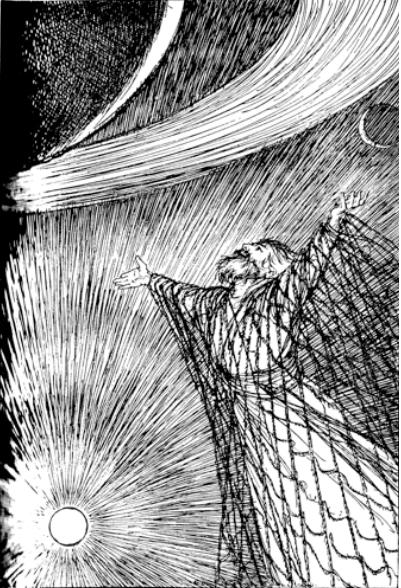
Up from Earth's Centre through the Seventh Gate
I rose, and on the Throne of Saturn sate,
And many Knots unravel'd by the Road;
But not the Knot of Human Death and Fate.
This is the thirty-first quatrain of Fitzgerald Rubaiyat. Before we delve into this quatrain, let's touch upon some ideas that these lines visit. In old world cosmology developed by Greeks from Plato to Ptolemy, the celestial model defined celestial orbits as spheres nested one within the other. These sphere touch the adjacent sphere in either directions. The earth was the centre of the universe and the seven spheres of the Moon, Mercury, Venus, Sun, Mars, Jupiter, and Saturn followed in that order. Saturn was the God of Agriculture in Roman mythology and his reign is shown as Golden Age of peace and bounty. More on celestial spheres can be read here.
The poet says I rose from the earth (the centre of the universe) and visited all the other spheres on my way to the last (seventh) sphere Saturn. On the seventh sphere, I besides, the throne of Saturn God, having travelled all the known spheres and seen all things possible over the years of my life. In midst of my journeys, I have untied my knots (mysteries) and unravelled many puzzles. But I have no answer for the problem of human Fate. I have failed to solve the riddle of human birth, death and destiny. The essence is the same as last two quatrains. I have visited the worlds known and worlds unknown. I have untangled many challenges over these years. But all my experiences and wisdom comes to cipher when trying to answer the questions of human condition.
The poet says I rose from the earth (the centre of the universe) and visited all the other spheres on my way to the last (seventh) sphere Saturn. On the seventh sphere, I besides, the throne of Saturn God, having travelled all the known spheres and seen all things possible over the years of my life. In midst of my journeys, I have untied my knots (mysteries) and unravelled many puzzles. But I have no answer for the problem of human Fate. I have failed to solve the riddle of human birth, death and destiny. The essence is the same as last two quatrains. I have visited the worlds known and worlds unknown. I have untangled many challenges over these years. But all my experiences and wisdom comes to cipher when trying to answer the questions of human condition.
Video Of The Day
NYTimes has come up with a simple to understand five minute video to explain the science and the method behind the discovery of Gravitational Waves by LIGO. Fascinating watch!
The main article on this topic in nytimes is here
The main article on this topic in nytimes is here
Translation - Kahte Hai Jeete Hain Umeed Pe Log (Ghalib)
ishq taasir se naumeed nahin
jaan-sipaarii sajar-e-biid nahin
Line 1/2 - Love is not disappointed by its impression/effect. Surrendering of life is not like a willow tree. The poet says that passion and love is not disappointed by its (lack of) effect. It is still hopeful that it will lead to fruition. Surrendering or sacrificing your life in path of love is unlike a willow tree which does not bear fruit. My love and my sacrifice will lead to success not like the willow tree that grows high and mighty but bears no fruits.
saltanate dast-bah-dast aai hai
jaam-e-mai kaatim-e-jamshed nahin
Line 3/4 - The empire has come from hand to hand. The cup of wine is not the seal of Jamshed. This is complicated to interpret. Jamshed the king used to have a special wine cup in which he can see the future. The first lines says that the reign of the empire goes from hand to hand. Hand to hand could mean being passed around by say inheritance (from father to son) or by show of hands (forcefully). So the empire passes from one person to another. But the cup of Jamshed is not the seal of his empire.The fabled cup of Jamshed is not like his seal which will be passed on from one ruler to another. This cup was only Jamshed to be and after him no one will get to have it.
hai tajalli tiriii saamaan-e-wajood
zarra be-partav-e-khurshid nahin
Line 5/6 - This radiance/splendor of yours is the reason for existence. The grain of sand is not without the reflection of the sun. The poet says referring to the God, that your manifestation and splendor is the cause/reason for the existence of everything. The greatness of Him is the reason for anything and everything to exist. Like the minuscule grain of sand that reflects the rays of the sun. Even the countless and unremarkable grains of sand shows His brilliance by reflecting the sun rays and showing that they too are part of His divine workings.
raaz-e-mashooq na rausva ho jaye
varna mar jaane mein kuch bhed nahin
Line 7/8 - The secret of the beloved does not become revealed/exposed. Otherwise there is no secret in dying. The poet says there is no mystery in dying. I would have sacrificed myself any day. The only reason I am no doing so is that my death would expose or reveal the secrets of my beloved and I do not want that to happen. My sudden death will raise questions and people may ultimately link it back to my beloved and some unwanted and unpleasant secrets could be exposed which I do not want. 'Bhed' also in commonplace language means difference. And this gives a dramatically different view. There is no difference in dying. The pain and agony of love makes living same as dying. The only reason I prefer living is that my death (due to the agony of love) will bring disrepute to the my beloved who is secret.
gaardish-e-rang-e-tarab se darr hain
gham-e-mahrumi-e-jaaviid nahin
Line 9/10 - I fear from the revolving/turning around of the colors of joy. I have no fear from the sorrow of eternal deprivation. The poet says I am fearful of the slow turning manner of the joy. One moment one think he is happy and slowly the feeling winds down. I fear this slowly turning around of emotions from joy to sadness. I do not fear the grief of living in everlasting neediness or want for one does not get these rhythms of joy and sadness in it. Life of never-ending want is easy to live then one where joy gives way to distressing sorrow. There is another interpretation possible. Suppose these lines are said in a reply to someone as a mild censure - You fear the turning around of joy to sorrow. But not the life of endless want! How come? Do you not know that life of eternal want is many times dreadful than one where joy slowly winds down.
kahte hai jeete hain umeed pe log
hum ko jeene ki bhi umeed nahin
Line 11/12 - They say that people live on hope. For we do not hope even for living. The poet says that people live on hope. As long as they are alive, they are hopeful of something. For them to be alive means to be hopeful, having a hope. But for us, we do not have any hope. Not even hope of living, leave aside living on hope. It a cyclical play of words that come out very well.
Meaning of difficult words -
taasir = impression, effect
sipaarii = surrender, sacrifice
sajar-e-biid - willow tree
dast = hand
kaatim - seal/stamp or finger ring
tajalli = manifestation, splendor, brilliance
tirii = yours
samaane-e-wajood = reason for existence
partav = reflection
khurshid = sun
rusva = dishonored, despondent
bhed = secret, mystery. difference
gaardish = turning round, adversity
tarab = joy
mahrumi-e-jaaviid = eternal deprivation
Read more posts on Ghalib.
jaan-sipaarii sajar-e-biid nahin
Line 1/2 - Love is not disappointed by its impression/effect. Surrendering of life is not like a willow tree. The poet says that passion and love is not disappointed by its (lack of) effect. It is still hopeful that it will lead to fruition. Surrendering or sacrificing your life in path of love is unlike a willow tree which does not bear fruit. My love and my sacrifice will lead to success not like the willow tree that grows high and mighty but bears no fruits.
saltanate dast-bah-dast aai hai
jaam-e-mai kaatim-e-jamshed nahin
Line 3/4 - The empire has come from hand to hand. The cup of wine is not the seal of Jamshed. This is complicated to interpret. Jamshed the king used to have a special wine cup in which he can see the future. The first lines says that the reign of the empire goes from hand to hand. Hand to hand could mean being passed around by say inheritance (from father to son) or by show of hands (forcefully). So the empire passes from one person to another. But the cup of Jamshed is not the seal of his empire.The fabled cup of Jamshed is not like his seal which will be passed on from one ruler to another. This cup was only Jamshed to be and after him no one will get to have it.
hai tajalli tiriii saamaan-e-wajood
zarra be-partav-e-khurshid nahin
Line 5/6 - This radiance/splendor of yours is the reason for existence. The grain of sand is not without the reflection of the sun. The poet says referring to the God, that your manifestation and splendor is the cause/reason for the existence of everything. The greatness of Him is the reason for anything and everything to exist. Like the minuscule grain of sand that reflects the rays of the sun. Even the countless and unremarkable grains of sand shows His brilliance by reflecting the sun rays and showing that they too are part of His divine workings.
raaz-e-mashooq na rausva ho jaye
varna mar jaane mein kuch bhed nahin
Line 7/8 - The secret of the beloved does not become revealed/exposed. Otherwise there is no secret in dying. The poet says there is no mystery in dying. I would have sacrificed myself any day. The only reason I am no doing so is that my death would expose or reveal the secrets of my beloved and I do not want that to happen. My sudden death will raise questions and people may ultimately link it back to my beloved and some unwanted and unpleasant secrets could be exposed which I do not want. 'Bhed' also in commonplace language means difference. And this gives a dramatically different view. There is no difference in dying. The pain and agony of love makes living same as dying. The only reason I prefer living is that my death (due to the agony of love) will bring disrepute to the my beloved who is secret.
gaardish-e-rang-e-tarab se darr hain
gham-e-mahrumi-e-jaaviid nahin
Line 9/10 - I fear from the revolving/turning around of the colors of joy. I have no fear from the sorrow of eternal deprivation. The poet says I am fearful of the slow turning manner of the joy. One moment one think he is happy and slowly the feeling winds down. I fear this slowly turning around of emotions from joy to sadness. I do not fear the grief of living in everlasting neediness or want for one does not get these rhythms of joy and sadness in it. Life of never-ending want is easy to live then one where joy gives way to distressing sorrow. There is another interpretation possible. Suppose these lines are said in a reply to someone as a mild censure - You fear the turning around of joy to sorrow. But not the life of endless want! How come? Do you not know that life of eternal want is many times dreadful than one where joy slowly winds down.
kahte hai jeete hain umeed pe log
hum ko jeene ki bhi umeed nahin
Line 11/12 - They say that people live on hope. For we do not hope even for living. The poet says that people live on hope. As long as they are alive, they are hopeful of something. For them to be alive means to be hopeful, having a hope. But for us, we do not have any hope. Not even hope of living, leave aside living on hope. It a cyclical play of words that come out very well.
Meaning of difficult words -
taasir = impression, effect
sipaarii = surrender, sacrifice
sajar-e-biid - willow tree
dast = hand
kaatim - seal/stamp or finger ring
tajalli = manifestation, splendor, brilliance
tirii = yours
samaane-e-wajood = reason for existence
partav = reflection
khurshid = sun
rusva = dishonored, despondent
bhed = secret, mystery. difference
gaardish = turning round, adversity
tarab = joy
mahrumi-e-jaaviid = eternal deprivation
Read more posts on Ghalib.
The Rubaiyat: Quatrain XXX

What, without asking, hither hurried whence?
And, without asking, whither hurried hence!
Another and another Cup to drown
The Memory of this Impertinence!
This is the thirtieth quatrain of FitzGerald's Rubaiyat. The first two lines state, we came hurriedly to this place (here) from that place without being asked. And we are hurriedly being taken from here to that place, again without being asked. The places where we coming from and going to are not mentioned. Are we going to the same place where we came from, the poet does not tell. These two lines are very similar in theme as the last quatrain where the poet laments over lack of control over life. The next two lines are bit more complex. These can be interpreted as cup after cup of wine is needed to drown the memory or the realization of this human condition. The acknowledgement of human frailty, of lack of control, of places and times unknown and beyond human grasp. The only way to block out these thoughts is to numb your senses by engaging in cups of wine. The poet could also be referring to that he needs cups of wine to overwhelm the feeling of injustice and improper conduct of God in making the human condition as it is.
Borges - Everything And Nothing (Summary)
This is a fascinating short story by Borges. The complete story is below (in italics). It is about a man who has no true self but only emptiness within him ("There was no one in him"). He is like a dream that was dreamt by no one. Ultimately he finds satisfaction as an actor where he plays 'somebody' so that others would not discover his nobodiness. In his countless plays, he played such an endless array of characters that he seemed to exhaust all possible destinies of man. He had died innumerable deaths and loved so much and endured so much that 'he had all men inside of him' and yet he had 'no one inside of him'. He had achieved the fundamental unity of existing, dreaming and acting. For twenty years he revelled in this theatre. One day realizing the terror of being no one, he retires and settle down in his native village. When he dies, he finds himself in presence of God and asks God that he just wanted to be himself. To which the God replied, that neither am I anyone. I have dreamed the world as you dreamed your work, my Shakespeare. One of the forms in dream are you who like me are many and yet no one. You are everything and nothing.
Borges touches on his familiar themes about God, the meaning of life and living and unity and multiplicity of existences or time. The last conversation between and actor and God is opaque in its interpretation and meaning. The idea that 'one man is all men' has been repeated multiple times in Borges's stories. Here the actor is no one and he is all men. He is unable to have a singular identity, a constant and an unchanging Self. He created multiple identities to give his life an identity. He was never meant to be anyone. He via his acts affects, empathises and simulates other people. Anything human is what he can be and he can feel and choose to be any other human. He identifies with all men. He is nothing in particular and yet everything, like a infinite space that is infinitely full and yet indefinitely empty. He feels and experiences situations and circumstances similarly as men who came before him felt and faced. His actions have been acted before. His pain and joys have been felt before. Whatever we do has a likeness to what has already happened to someone else. His destiny is no different from the destiny of all men. What happens to him will happen to all the men for they share the collective experience and a collective destiny. He is nothing that has already not happened or going to happen. Same is to God which is this constant idea, a constance presence in all the forms that one sees. The forms are all His many dreams, his many creations and like Man, He is many and yet He is no one. He is a dream of forms he dreamt. Without the creation he dreamt, He is nothing. He is all things and He is none.
There was no one in him: behind his face (which even through the bad paintings of those times resembles no other) and his words, which were copious, fantastic and stormy, there was only a bit of coldness, a dream dreamt by no one. At first he thought that all people were like him, but the astonishment of a friend to whom he had begun to speak of this emptiness showed him his error and made him feel always that an individual should not differ in outward appearance.Once he thought that in books he would find a cure for his ill and thus he learned the small Latin and less Greek a contemporary would speak of; later he considered that what he sought might well be found in an element rite of humanity, and let himself be initiated by Anne Hathaway one long June afternoon. At the age of twenty-odd years he went to London. Instinctively he had already become proficient in the habit of simulating that he was someone, so that others would not discover his condition as no one; in London he found the profession to which he was predestined, that of the actor, who on a stage plays at being another before a gathering of people who play at taking him for that other person. His histrionic tasks brought him a singular satisfaction, perhaps the first he had ever known; but once the last verse had been acclaimed and the last dead man withdrawn from the stage, the hated flavor of unreality returned to him. He ceased to be Ferrex or Tamerlane and became no one again. Thus hounded, he took to imagining other heroes and other tragic fables. And so, while his flesh fulfilled its destiny as flesh in the taverns and brothels of London, the soul that inhabited him was Caesar, who disregards the augur's admonition, and Juliet, who abhors the lark, and Macbeth, who converses on the plain with the witches who are also Fates. No one has ever been so many men as this man, who like the Egyptian Proteus could exhaust all the guises of reality. At times he would leave a confession hidden away in some corner of his work, certain that it would not be deciphered; Richard affirms that in his person he plays the part of many and lago claims with curious words "I am not what I am," The fundamental identity of existing, dreaming and acting inspired famous passages of his.
For twenty years he persisted in that controlled hallucination, but one morning he was suddenly gripped by the tedium and the terror of being so many kings who die by the sword and so many suffering lovers who converge, diverge and melodiously expire. That very day he arranged to sell his theater. Within a week he had returned to his native village, where he recovered the trees and rivers of his childhood and did not relate them to the others his muse had celebrated, illustrious with mythological allusions and Latin terms. He had to be someone; he was a retired impresario who had made his fortune and concerned himself with loans, lawsuits and petty usury. It was in this character that he dictated the arid will and testament known to us, from which he deliberately excluded all traces of pathos or literature. His friends from London would visit his retreat and for them he would take up again his role as poet.
History adds that before or after dying he found himself in the presence of God and told Him: "I who have been so many men in vain want to be one and myself." The voice of the Lord answered from a whirlwind: "Neither am I anyone; I have dreamt the world as you dreamt your work, my Shakespeare, and among the forms in my dream are you, who like myself are many and no one." -- By Jorge Luis Borges (Translated by James E. Irby)


Thought Of The Day
We have come to a stage where the aesthetics of the newly acquired book shelf engages more conversation than the type of books that are on the bookshelf. The content of the message has been lost in hubris or our so called busy-ness or plain nonchalance, but the messenger still evokes frantic sentiments on all sides of the spectrum. Since when did we became so partisan and hacks for someone's agenda. No one reads the story these days, people go straight to the comments section to check out the abuse happening around or promote their own bias. Any sane debate or view point is lost in this theater of the absurd. And now this theater pervades all around from art to politics to media to everyday lives, covering the real.
“Anti-intellectualism has been a constant thread winding its way through our political and cultural life, nurtured by the false notion that democracy means that 'my ignorance is just as good as your knowledge.'”
- Isaaac Asimov
Frits Staal - Discovering the Vedas (Summary - I)
I have always been fascinated by how cultures developed overtime. Early humans foraging for food and shelter slowly come together to form a settlement that ultimately becomes part of a bigger civilization. Language develops, Gods are created and venerated and a basis of religion is formed. I am currently reading Frits Staal's book - "Discovering the Vedas". This is the first book I am reading on how early Hinduism came into being and it has found me all excited. The premise of the book is since early Vedic civilization left no records (like built structures or written text), the starting point for how to describe the times would be the Vedas itself and if we can de-construct them, we can understand the broad contours of the time and space that they were created in. The below write up is a broad summary of the first section of the book and I will try to come up with similar summaries of other sections as well. In no way whatsoever the ideas puts forward in this book are definitive but it is definitely worthy of a thought.
So what is Vedas? - Vedas are archaic text that are regarded as 'revealed' or sruti, or literally 'what is heard' by sages from the Gods. But they are of human origin written by early Vedic scholars and are basically hymns used to address and invoke Gods. They were passed from teacher to pupils orally [called as Oral Tradition] over a thousands of years and were created in early Vedic language which is archaic form of classical Sanskrit. Vedic (or early classical Sanskrit) is one of the many Indo-Iranian language that rose during that prolific time that ultimately all trace back to a common Indo-European ancestor language. Vedas were finally written down sometime in the early Common Era. Contrary to common knowledge, Vedas were not created in one piece or one place. They were composed in multiple places over a long period of time and some feature are not be even part of Indian subcontinent. Rig Veda is most archaic and other three Vedas depend and quote it extensively.
Where were they written? - The book states that Rig Veda (RV) records the name of rivers of north west India and Pakistan extensively. So they must have been created in or in vicinity of north west India. Harappa civilization existed in the same region around 3000 BC to 1800 BC and it was well known for the proper city planning and fired bricks. But RV never mentions of cities or bricks in its verses. It talks of fort with mud walls but never of bricks. In RV, there is mention of mythical river Saraswati flowing in north west India. Saraswati has the same language origins as with another river called as Haraxaiti [river Helmand in Afghanistan]. Both words sound very similar and have same meaning [i.e. river with ponds or that dries in desert]. The book puts forwards a theory that early Vedic people knew about Haraxaiti as they lived around it and when they moved to north west India and when they found a similar river there, they named it similarly. Like English migrants named New England in US when they came from England and found it similar. Hence Vedas were likely composed in north west India with rivers and early tribes names providing the geographical fingerprint. The centre of the Vedic culture slowly kept moving west starting in frontier Pakistan and ultimately moving to the Gangetic plains of Bihar.(where later Vedic text was composed)
When were they written? - The current generally accepted time of composition of RV is around 1500 BC. Harappa culture was also in the same space (north west India), but they never shared time. So RV was either pre-3000 BC or post-1800 BC as Harappa culture existed during this period and they both seem to be mutually exclusive. More on timelines later when we discuss the origin of early Vedic people.
Where did early Vedic people came from? - This is the big question and the book proposes a theory which many may not necessarily agree. The book briefly touches on genetic make-up of Indian population (caste or otherwise) and states that the predominant DNA material goes back to 9000 years and Vedic people can not contribute so much of DNA material so long back. It also mentions of another source where a similar ancient Vedic culture sprung up (more on Mitanni on wiki). In ancient middle east, there was a treaty between Hittite kingdom (modern day Turkey) and Mitanni kingdom (modern day Syria/North Iraq) that refers to Vedic gods of Indra and Varuna. Mitanni nobles spoke of language that was very very close to Vedic. The text tablets of the treaty are dated around 1400 BC and are basically horse training and chariots making manuals for fighting wars. Now to posit that a group of Vedic people moved from India to modern day Syria does not cut ice. Most likely a group of near-Vedic speaking people wandering around split and some came to India while the other group went to middle east taking with them the language and equestrian skills. Mitanni nobles had knowledge of something that allowed them to rule the more numerous natives. Maybe in India something similar happened that allowed a small group of people to become kings and chiefs and they slowly kept moving west.These people brought with them the power of written language and the skills of horse and chariots (spoke based chariots that are much faster) over the mountains to north west India. Harappa culture had no written language. Probably the idea of a written text filled the gap. The language also brought with itself the power of mantra and myth to invoke Gods that may have added to the power of ruling elite besides the charm of the language. Horses were introduced from else where as they were not native to India. They were not present in Harappa culture but they are everywhere in RV. It points that horses and chariots were fashionable as probably they were new to the land. The overall premise of the book being that instead of an big Aryan invasion (as is generally thought of), maybe Vedic people trickled over the mountains in small numbers and settled over time and became royalty as they had the skills alien to the land (i.e horses, chariots, language, mantra and myth) but fashionable.
How does this all hang together? - The book proposes that the origins of early Vedic people were most likely somewhere in Sintashta culture (in Russian steppes, south of Ural mountains that developed around 2100-1800 BC). In Sintashta culture which was primarily a Indo-European or maybe Indo-Iranian language culture, evidence of early chariots and horse/fire sacrifice have been found extensively. This culture is further north of another culture called BMAC which is a non Indo-European culture located on the banks of Amu Darya river in Central Asia. One wave of people from Sintashta move south via BMAC into northern Iran where they form the basis of early Iranian culture and language [Avestan/Zoroastrianism]. At the same time, another set of people from Sintashta start moving east on to wide empty plains of Kazakhstan and continue moving east to what is now called as Chinese Xinjiang. Here in the dry Tarim basin countless mummies have been found dating to 2000 BC with Indo-European features. During this long trek over mountains and deserts the language started changing from India-Iranian into Vedic. High in the mountains the early Vedic people find the plant Soma which is heavily mentioned in Vedas for its stimulant qualities and is said to grow near Mount Mūjavant. The author proposes that Mount Mūjavant could be Muz-tagh Ata near the Pamir mountains. After crossing the Pamir, north of Karakoram the nomads enter Afghanistan. Here they mingle with the BMAC culture and influence each other. Number of non-Indo-European words are picked and added into the Vedic vocabulary here. This maybe dated around 1800 BC. Once in BMAC, they split, one goes west to formed Mitanni state [in 1500 BC] and the other moved to north west India via Khyber pass. This fits nicely with linguistic side as Vedic and Mittani are more similar then say Iranian and Mitanni. Another set of people moved further south and entered India via Bolan pass picking the Iranian word Haraxaiti from eastern Iran. So somewhere around 1500 B.C.,the early settlers settle themselves in northern India bringing with them the power of language and art of horse riding and fast chariots. In fact Harappa has toys with solid wheels but RV never mentions solid wheels and instead has whole terminology for chariots and its parts showing that it was more fashionable and probably an in-demand skill at that time. This brings us to the end of the first section that provides a brief take on that era when early Vedic civilization rose.
Whatever the author proposes is difficult to prove one way or other but I find one thing hard to believe. While the origin of Vedic people may be in Sintashta culture of the Russian steppes or near about, but the idea of large number of people along with their women/children and possibly livestock as well moving around in such treacherous and nearly inhospitable terrain of Pamir and Tarim is difficult to comprehend. Would it not been easier for them to just move south to BMAC directly and then enter India via Khyber taking along with them the horse and the chariot. At least this route is easier and more live-able. Well! we will never know the answer!
So what is Vedas? - Vedas are archaic text that are regarded as 'revealed' or sruti, or literally 'what is heard' by sages from the Gods. But they are of human origin written by early Vedic scholars and are basically hymns used to address and invoke Gods. They were passed from teacher to pupils orally [called as Oral Tradition] over a thousands of years and were created in early Vedic language which is archaic form of classical Sanskrit. Vedic (or early classical Sanskrit) is one of the many Indo-Iranian language that rose during that prolific time that ultimately all trace back to a common Indo-European ancestor language. Vedas were finally written down sometime in the early Common Era. Contrary to common knowledge, Vedas were not created in one piece or one place. They were composed in multiple places over a long period of time and some feature are not be even part of Indian subcontinent. Rig Veda is most archaic and other three Vedas depend and quote it extensively.
Where were they written? - The book states that Rig Veda (RV) records the name of rivers of north west India and Pakistan extensively. So they must have been created in or in vicinity of north west India. Harappa civilization existed in the same region around 3000 BC to 1800 BC and it was well known for the proper city planning and fired bricks. But RV never mentions of cities or bricks in its verses. It talks of fort with mud walls but never of bricks. In RV, there is mention of mythical river Saraswati flowing in north west India. Saraswati has the same language origins as with another river called as Haraxaiti [river Helmand in Afghanistan]. Both words sound very similar and have same meaning [i.e. river with ponds or that dries in desert]. The book puts forwards a theory that early Vedic people knew about Haraxaiti as they lived around it and when they moved to north west India and when they found a similar river there, they named it similarly. Like English migrants named New England in US when they came from England and found it similar. Hence Vedas were likely composed in north west India with rivers and early tribes names providing the geographical fingerprint. The centre of the Vedic culture slowly kept moving west starting in frontier Pakistan and ultimately moving to the Gangetic plains of Bihar.(where later Vedic text was composed)
When were they written? - The current generally accepted time of composition of RV is around 1500 BC. Harappa culture was also in the same space (north west India), but they never shared time. So RV was either pre-3000 BC or post-1800 BC as Harappa culture existed during this period and they both seem to be mutually exclusive. More on timelines later when we discuss the origin of early Vedic people.
Where did early Vedic people came from? - This is the big question and the book proposes a theory which many may not necessarily agree. The book briefly touches on genetic make-up of Indian population (caste or otherwise) and states that the predominant DNA material goes back to 9000 years and Vedic people can not contribute so much of DNA material so long back. It also mentions of another source where a similar ancient Vedic culture sprung up (more on Mitanni on wiki). In ancient middle east, there was a treaty between Hittite kingdom (modern day Turkey) and Mitanni kingdom (modern day Syria/North Iraq) that refers to Vedic gods of Indra and Varuna. Mitanni nobles spoke of language that was very very close to Vedic. The text tablets of the treaty are dated around 1400 BC and are basically horse training and chariots making manuals for fighting wars. Now to posit that a group of Vedic people moved from India to modern day Syria does not cut ice. Most likely a group of near-Vedic speaking people wandering around split and some came to India while the other group went to middle east taking with them the language and equestrian skills. Mitanni nobles had knowledge of something that allowed them to rule the more numerous natives. Maybe in India something similar happened that allowed a small group of people to become kings and chiefs and they slowly kept moving west.These people brought with them the power of written language and the skills of horse and chariots (spoke based chariots that are much faster) over the mountains to north west India. Harappa culture had no written language. Probably the idea of a written text filled the gap. The language also brought with itself the power of mantra and myth to invoke Gods that may have added to the power of ruling elite besides the charm of the language. Horses were introduced from else where as they were not native to India. They were not present in Harappa culture but they are everywhere in RV. It points that horses and chariots were fashionable as probably they were new to the land. The overall premise of the book being that instead of an big Aryan invasion (as is generally thought of), maybe Vedic people trickled over the mountains in small numbers and settled over time and became royalty as they had the skills alien to the land (i.e horses, chariots, language, mantra and myth) but fashionable.
How does this all hang together? - The book proposes that the origins of early Vedic people were most likely somewhere in Sintashta culture (in Russian steppes, south of Ural mountains that developed around 2100-1800 BC). In Sintashta culture which was primarily a Indo-European or maybe Indo-Iranian language culture, evidence of early chariots and horse/fire sacrifice have been found extensively. This culture is further north of another culture called BMAC which is a non Indo-European culture located on the banks of Amu Darya river in Central Asia. One wave of people from Sintashta move south via BMAC into northern Iran where they form the basis of early Iranian culture and language [Avestan/Zoroastrianism]. At the same time, another set of people from Sintashta start moving east on to wide empty plains of Kazakhstan and continue moving east to what is now called as Chinese Xinjiang. Here in the dry Tarim basin countless mummies have been found dating to 2000 BC with Indo-European features. During this long trek over mountains and deserts the language started changing from India-Iranian into Vedic. High in the mountains the early Vedic people find the plant Soma which is heavily mentioned in Vedas for its stimulant qualities and is said to grow near Mount Mūjavant. The author proposes that Mount Mūjavant could be Muz-tagh Ata near the Pamir mountains. After crossing the Pamir, north of Karakoram the nomads enter Afghanistan. Here they mingle with the BMAC culture and influence each other. Number of non-Indo-European words are picked and added into the Vedic vocabulary here. This maybe dated around 1800 BC. Once in BMAC, they split, one goes west to formed Mitanni state [in 1500 BC] and the other moved to north west India via Khyber pass. This fits nicely with linguistic side as Vedic and Mittani are more similar then say Iranian and Mitanni. Another set of people moved further south and entered India via Bolan pass picking the Iranian word Haraxaiti from eastern Iran. So somewhere around 1500 B.C.,the early settlers settle themselves in northern India bringing with them the power of language and art of horse riding and fast chariots. In fact Harappa has toys with solid wheels but RV never mentions solid wheels and instead has whole terminology for chariots and its parts showing that it was more fashionable and probably an in-demand skill at that time. This brings us to the end of the first section that provides a brief take on that era when early Vedic civilization rose.
Whatever the author proposes is difficult to prove one way or other but I find one thing hard to believe. While the origin of Vedic people may be in Sintashta culture of the Russian steppes or near about, but the idea of large number of people along with their women/children and possibly livestock as well moving around in such treacherous and nearly inhospitable terrain of Pamir and Tarim is difficult to comprehend. Would it not been easier for them to just move south to BMAC directly and then enter India via Khyber taking along with them the horse and the chariot. At least this route is easier and more live-able. Well! we will never know the answer!
Translation - Dard Ho Dil Main Toh Dawa (Ghalib)
dard ho dil main toh dawa keejay
dil hi jab dard ho toh kiya keejay
Line 1/2 - When pain afflicts the heart, medicine needs to be done. When heart itself is pain, then what to do? Such a easy going colloquial lines best for any occasion! The poet says when there is pain in the heart, a medicine would do the trick. But when the heart itself is one causing pain, when the grief of the heart is so overwhelming, then what needs to be done.
hum ko fariyaad karni aati hai
aap suntay nahi toh kiya keejay
Line 3/4 - We know how to complain/appeal.You do not listen, what to do? The point referring to the apathy and harsh indifference of the beloved and laments what more he needs to do to get her attention. The lines could also be interpreted as Ghalib's multiple appeals to indifferent English officers & declining Mughal empire to get his pensions restored in which he ultimately fails.
in butoon ko khuda se kiya matlab
tauba tauba , khuda khuda , keejay
Line 5/6 - What meaning do these idols have with God. Heavens forbid, Pray to God! The poet says what these idols that you so adore have to do with God. Repent now and pray to God and ask for forgiveness!
ranj uthanay say bhi khushi ho gi
pahlay dil dard aashna keejay
Line 7/8 - Bearing grief too will bring happiness. First, adjust your heart to be friends with pain. This is the best lines of this ghazal. The poet points that one has look inside of themselves for comfort in state of utter loneliness and grief. Grief too will bring happiness, but first make your heart accept pain and then grief will no longer hurt that much!
arz -e- shookhi , nishat -e- alam hai
husn ko aur khud numa keejay
Line 9/10 - This coquetry and playfulness that you exhibit, is the joy of the world. Un-hide yourself some more of the beauty you possess. The poet says to his beloved that her behavior is the ecstasy that the world cherishes and long for. Show them some more of your beauty for the world waits for it.
dushmani ho chuki ba qadr wafa
ab haq -e- dosti ada keejay
Line 11/12 - We have become enemies on the account of (lack of) loyalty. Now pay the dues of the claim to the friendship. This can also be read as enmity has become to the extent of loyalty. Now pay the dues of the right to the friendship. I like the second interpretation better. The poet says we were enemies earlier but now that enmity has turned to loyalty. Please pay the dues (favors that I may have) of the right to our friendship now.
maut aati nahi kaheen Ghalib
kab tak afsoos ziist ka keejay
Line 13/14 - The end (death) does not come somehow, Ghalib. Till when do we need to feel regret for this life. The poet says death does not come even though I have been in wait for it. Till what time should we continue to feel sorry for life. Instead of this hopeless existence, I would have wanted death but that is not coming on it own and so life goes on in its usual pace.
Meaning of difficult words -
taubah = swore off
ranj = grief
aashna = good friend
arz = to exhibit
shookhi = playfulness, mischief; coquetry,
nishat = joy, happiness
alam = world
numa = to show, to unhide
ba-qadr = to the extent of, according to
wafa = loyalty
ziist = life, existence
dil hi jab dard ho toh kiya keejay
Line 1/2 - When pain afflicts the heart, medicine needs to be done. When heart itself is pain, then what to do? Such a easy going colloquial lines best for any occasion! The poet says when there is pain in the heart, a medicine would do the trick. But when the heart itself is one causing pain, when the grief of the heart is so overwhelming, then what needs to be done.
hum ko fariyaad karni aati hai
aap suntay nahi toh kiya keejay
Line 3/4 - We know how to complain/appeal.You do not listen, what to do? The point referring to the apathy and harsh indifference of the beloved and laments what more he needs to do to get her attention. The lines could also be interpreted as Ghalib's multiple appeals to indifferent English officers & declining Mughal empire to get his pensions restored in which he ultimately fails.
in butoon ko khuda se kiya matlab
tauba tauba , khuda khuda , keejay
Line 5/6 - What meaning do these idols have with God. Heavens forbid, Pray to God! The poet says what these idols that you so adore have to do with God. Repent now and pray to God and ask for forgiveness!
ranj uthanay say bhi khushi ho gi
pahlay dil dard aashna keejay
Line 7/8 - Bearing grief too will bring happiness. First, adjust your heart to be friends with pain. This is the best lines of this ghazal. The poet points that one has look inside of themselves for comfort in state of utter loneliness and grief. Grief too will bring happiness, but first make your heart accept pain and then grief will no longer hurt that much!
arz -e- shookhi , nishat -e- alam hai
husn ko aur khud numa keejay
Line 9/10 - This coquetry and playfulness that you exhibit, is the joy of the world. Un-hide yourself some more of the beauty you possess. The poet says to his beloved that her behavior is the ecstasy that the world cherishes and long for. Show them some more of your beauty for the world waits for it.
dushmani ho chuki ba qadr wafa
ab haq -e- dosti ada keejay
Line 11/12 - We have become enemies on the account of (lack of) loyalty. Now pay the dues of the claim to the friendship. This can also be read as enmity has become to the extent of loyalty. Now pay the dues of the right to the friendship. I like the second interpretation better. The poet says we were enemies earlier but now that enmity has turned to loyalty. Please pay the dues (favors that I may have) of the right to our friendship now.
maut aati nahi kaheen Ghalib
kab tak afsoos ziist ka keejay
Line 13/14 - The end (death) does not come somehow, Ghalib. Till when do we need to feel regret for this life. The poet says death does not come even though I have been in wait for it. Till what time should we continue to feel sorry for life. Instead of this hopeless existence, I would have wanted death but that is not coming on it own and so life goes on in its usual pace.
Meaning of difficult words -
taubah = swore off
ranj = grief
aashna = good friend
arz = to exhibit
shookhi = playfulness, mischief; coquetry,
nishat = joy, happiness
alam = world
numa = to show, to unhide
ba-qadr = to the extent of, according to
wafa = loyalty
ziist = life, existence
Photo Of The Day


The Rubaiyat: Quatrain XXIX

Into this Universe, and why not knowing,
Nor whence, like Water willy-nilly flowing,
And out of it, as Wind along the Waste,
I know not whither, willy-nilly blowing.
This is the twenty-ninth quatrain of the Fitzgerald's Rubaiyat. The use of wind and water is reminiscent of the previous quatrain where poet says life is like wind and water, without form and direction. In this quatrain Khayyam says we came into this world not knowing the purpose and not knowing where did we come from. It is like water that rains or flows over which we have no control. Such is the essence of life whether we like it or not. My coming to this world does not happen on my accord. And we leave this world not knowing where we will be going to. We leave like wind blowing not knowing where it will blow and having no control over it whether one like it or not. I had no choice if I wanted to be bought up in this world nor do I have one when I leave this world. The theme of this quatrain is similarly expressed by Zauq in this famous work - layi hayaat aaye qaaza la chali chale
existence bought me and I came, death took me away and I went.
I neither came on my own will, nor did I go off my own accord.
existence bought me and I came, death took me away and I went.
I neither came on my own will, nor did I go off my own accord.
Translation - Ibn-e-Mariyam Hua Kare Koi (Ghalib)
ibn-e-mariyam huwa kare koee
mere dukh kee dawa kare koee
Line 1/2 - Let someone be the Son of Mary (Jesus), let someone cure me of my sorrow/grief. The poet says if there is a messiah somewhere, let him cure me of my grief. If someone is claiming to be Son of God, first cure me and then I will believe him. The use of 'huwa kare koi' in the first line, make it wide open to interpretations. If someone is, or someone is claiming to be or someone wants to be or even I don't care if someone becomes one. All variations are plausible!
shar'a-o-aaeen par madaar sahee
'eise qaatil ka kya kare koee ?
Line 3/4 - Even on the basis of sharia and the law of the land, What should one do of such a murderer. The poet referring to her beloved says what can the religious law or the law of the land do of such a murderer as my beloved. How are they equipped to handle such crimes? Even the laws of God and of the Land are ill-equipped to handle my beloved murderer.
Line 7/8 - On the word/talk, there the tongue was cut. She would say and someone else would listen. The poet says, when anything is said then the tongue may be cut for she does not like what is being said. But when she says, than nothing is going to happen. She keeps on saying and people have to listen to it. Cutting of tongue is figurative as if to interrupt or humiliate. She would humiliate if someone was to say something which she did not like. But when she speaks, we can not even complain.
Line 13/14 - Stop them, if someone is walking wrongly (on a wrong path). Forgive them, if someone is doing something wrong.
Line 15/16 -Who is such that they are not needy? Whose need someone might fulfill? The poet says who is in this world who is not needy. Everyone is desirous of something. How will we fulfill the needs of such? When everyone is needy how to decide whom to serve? Another stream of thought is how to fulfill the need of other when one is itself needy?
kya kiyaa khijr ne sikandar se
ab kise rehnuma kare koee ?
Line 17/18 - What did Khizr did to Alexander? Now who should someone take as guide? Here is a legend that Khizr (who is prophet who guides people those are lost) guides Alexander to the Fountain Of Life. But Alexander does not drink from it and later in his quests he dies early. The poet says what did a guide like Khizr accomplish for Alexander? He could not even convince Alexander to drink from the fountain. Whom should we trust enough to be our guide when even Khizr was found wanting?
jab tavaqqo hee uth gayee 'ghalib'
kyon kisee ka gila kare koee ?
Line 19/20 - When expectation itself have taken off, Ghalib. Why someone would complain about someone? The poet says that I had no expectations, and hence why would I be bitter and complaining about anyone. I was not even anticipating any favors. A second stream of thought can be, that when hope (personified) has itself departed me, I do not care now if any one else is leaving me or not.
Meaning of difficult words -
ibn = son/child
mariyam = virgin Mary
shar'a = the Islamic law
aaeen = law/custom/mode
madaar = orbit/circumference/a place of turning
kadee = link in a chain
kaman = bow
jaa = space
junoon = ecstasy
haajat_mand = person in need
haajat = need
rawa = fulfill
tavaqqo = expectations
gila = complaint
Read more posts on Ghalib.
mere dukh kee dawa kare koee
Line 1/2 - Let someone be the Son of Mary (Jesus), let someone cure me of my sorrow/grief. The poet says if there is a messiah somewhere, let him cure me of my grief. If someone is claiming to be Son of God, first cure me and then I will believe him. The use of 'huwa kare koi' in the first line, make it wide open to interpretations. If someone is, or someone is claiming to be or someone wants to be or even I don't care if someone becomes one. All variations are plausible!
shar'a-o-aaeen par madaar sahee
'eise qaatil ka kya kare koee ?
Line 3/4 - Even on the basis of sharia and the law of the land, What should one do of such a murderer. The poet referring to her beloved says what can the religious law or the law of the land do of such a murderer as my beloved. How are they equipped to handle such crimes? Even the laws of God and of the Land are ill-equipped to handle my beloved murderer.
chaal, jaise kadee kamaan ka teer
dil mein 'eise ke jaa kare koee
Line 5/6 - Walk like an arrow fired from a tightly strung bow. In the heart like this, let someone find a place. The poet says that the beloved walks like as if an arrow has been let go from a strung bow. The arrow instantly finds the heart (the intended target) and so does my beloved.
baat par waan zubaan kat_tee hai
woh kahain aur suna kare koee
dil mein 'eise ke jaa kare koee
Line 5/6 - Walk like an arrow fired from a tightly strung bow. In the heart like this, let someone find a place. The poet says that the beloved walks like as if an arrow has been let go from a strung bow. The arrow instantly finds the heart (the intended target) and so does my beloved.
baat par waan zubaan kat_tee hai
woh kahain aur suna kare koee
Line 7/8 - On the word/talk, there the tongue was cut. She would say and someone else would listen. The poet says, when anything is said then the tongue may be cut for she does not like what is being said. But when she says, than nothing is going to happen. She keeps on saying and people have to listen to it. Cutting of tongue is figurative as if to interrupt or humiliate. She would humiliate if someone was to say something which she did not like. But when she speaks, we can not even complain.
bak rahaa hoon junoon mein kya kya kuchch
kuchch na samjhe khuda kare koee
Line 9/10 - In the state of passion, I am babbling I don't know what. May God grant that no one understands any of it. The poet says in this state of madness, I don't know what I was babbling. Maybe I may have let out a secret. May God grant that now one understood whatever I said. I do not want people of know the state of my mind or my affairs. Let them think me of as a mad!
na suno gar bura kahe koee
na kaho gar bura kare koee
Line 11/12 - Do not listen if someone is saying something bad. Do not say, if someone is doing something bad. The first line is pretty clear. Do not listen if some ill is being said. It is better to not be part of such slander. But the second lines is not very clear. If someone is doing evil, do not say. Do not say to whom? to the evil-doer, to anyone else about the evil-doer? Or maybe do not bring the evil deed on to your lips. Do not even repeat it.
rok lo, gar ghalat chale koee
bakhsh do gar khata kare koee
kuchch na samjhe khuda kare koee
Line 9/10 - In the state of passion, I am babbling I don't know what. May God grant that no one understands any of it. The poet says in this state of madness, I don't know what I was babbling. Maybe I may have let out a secret. May God grant that now one understood whatever I said. I do not want people of know the state of my mind or my affairs. Let them think me of as a mad!
na suno gar bura kahe koee
na kaho gar bura kare koee
Line 11/12 - Do not listen if someone is saying something bad. Do not say, if someone is doing something bad. The first line is pretty clear. Do not listen if some ill is being said. It is better to not be part of such slander. But the second lines is not very clear. If someone is doing evil, do not say. Do not say to whom? to the evil-doer, to anyone else about the evil-doer? Or maybe do not bring the evil deed on to your lips. Do not even repeat it.
rok lo, gar ghalat chale koee
bakhsh do gar khata kare koee
Line 13/14 - Stop them, if someone is walking wrongly (on a wrong path). Forgive them, if someone is doing something wrong.
kaun hai jo naheen hai haajat_mand ?
kiskee haajat rawa kare koee
kiskee haajat rawa kare koee
Line 15/16 -Who is such that they are not needy? Whose need someone might fulfill? The poet says who is in this world who is not needy. Everyone is desirous of something. How will we fulfill the needs of such? When everyone is needy how to decide whom to serve? Another stream of thought is how to fulfill the need of other when one is itself needy?
kya kiyaa khijr ne sikandar se
ab kise rehnuma kare koee ?
Line 17/18 - What did Khizr did to Alexander? Now who should someone take as guide? Here is a legend that Khizr (who is prophet who guides people those are lost) guides Alexander to the Fountain Of Life. But Alexander does not drink from it and later in his quests he dies early. The poet says what did a guide like Khizr accomplish for Alexander? He could not even convince Alexander to drink from the fountain. Whom should we trust enough to be our guide when even Khizr was found wanting?
jab tavaqqo hee uth gayee 'ghalib'
kyon kisee ka gila kare koee ?
Meaning of difficult words -
ibn = son/child
mariyam = virgin Mary
shar'a = the Islamic law
aaeen = law/custom/mode
madaar = orbit/circumference/a place of turning
kadee = link in a chain
kaman = bow
jaa = space
junoon = ecstasy
haajat_mand = person in need
haajat = need
rawa = fulfill
tavaqqo = expectations
gila = complaint
Read more posts on Ghalib.
Subscribe to:
Posts (Atom)