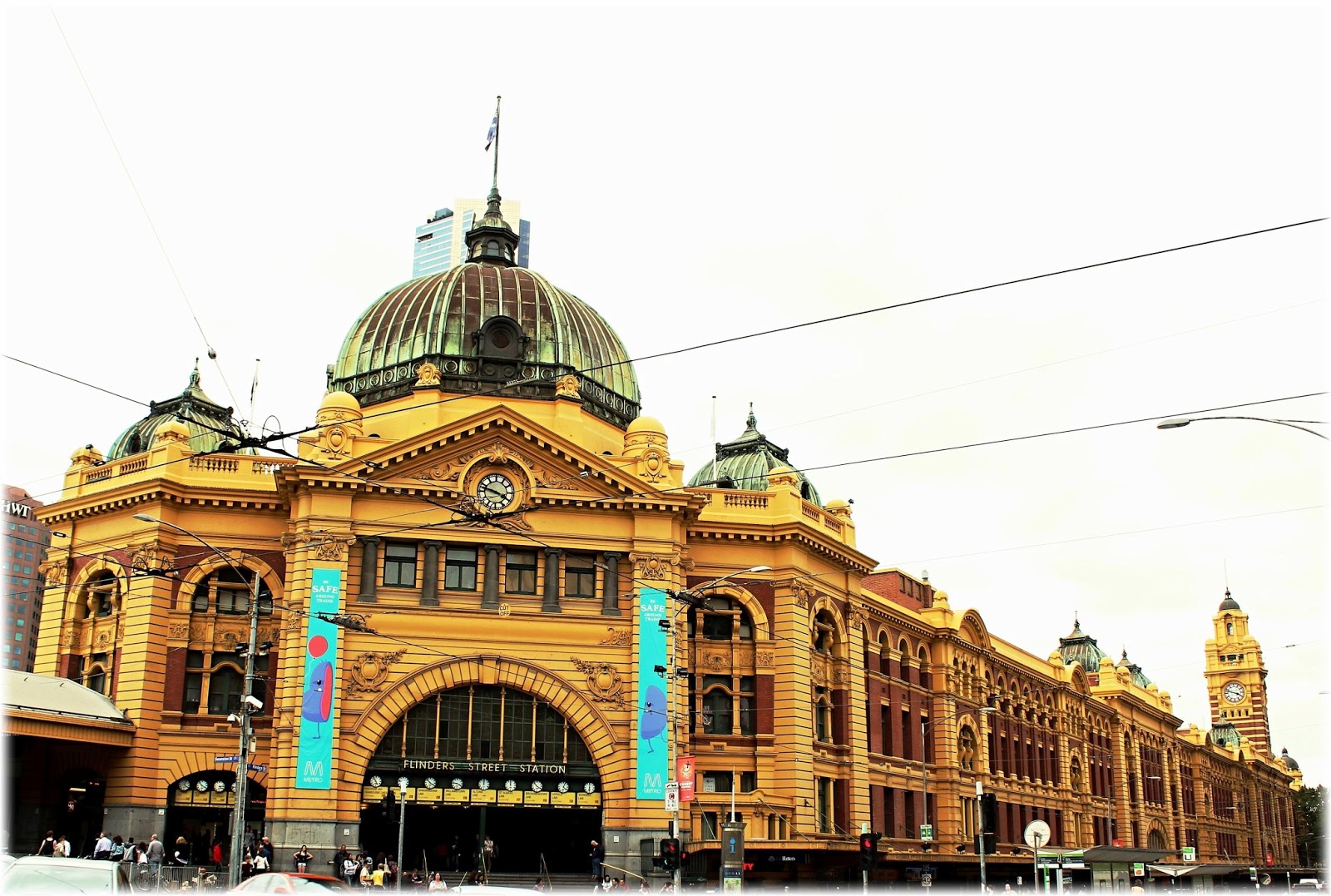
Photo Of The Day

Flinders Street Station, Melbourne

Shrine Of Remembrance, Melbourne

Translation - Kab Se Hoon, Kya Bataaon (Ghalib)

miltee hai khoo-e-yaar se naar iltihaab mein
kaafir hoon gar na miltee ho raahat 'azaab mein

Line 1/2 - The poet says his beloved's temperament matches the fiery flames of the fire. I would be an infidel if I do not find solace in sorrow. Ghalib in his despair says his lover's behavior is like the searing flames of the fire. It is passionate and intense, and I would be a non-believer if I do not find comfort in torment. I am in sorrow and already in anguish hence I find comfort in the fiery habits of my lover. They don't bother me. But if they start to annoy me, then assume that I am no more a believer that I used to be.

kab se hoon, kya bataaoon jahaan-e-kharaab mein?
shab haaye hijr ko bhee rakhoon gar hisaab mein

Line 3/4 - Ghalib says that 'What to say! Since how long I have been in this world of misfortune and misery'. Even if I account for the misery due to your nights of separation into this. Now this can be interpreted in multiple ways. The poet says that his life has long been in this world of grief and affliction. If I take care of the torment/misery due to our separation still my world would be sad and amiss. In other interpretation, Ghalib says his long he has been in wretched world and those nights of separation from you are just more addition in those woeful times. My beloved's company makes this world joyful and without her, it is another day in this wretched world.

taa fir na intezaar mein neend aaye 'umr bhar
aane ka 'ahad kar gaye aaye jo khwaab mein

Line 5/6 - The poet says 'So that, in waiting - sleep may never come in my entire lifetime, she came in my dreams and promised that she would come'. Ghalib says I am waiting for my beloved eagerly and so excited am I that I can not rest until she comes. Sleep may never come close to my eyes until I see her face for she came to my dreams and promised that she is going to come and meet me.

qaasid ke aate-aate khat ik aur likh rakhoon
main jaanta hoon jo woh likhenge jawaab mein

Line 7/8 - Ghalib says by the time the messenger comes, he will write another letter and keep it handy. For I know what she is going to write in her reply. Again couple of interpretation, One he knows his beloved so well that he knows what she has written in the letter and he want to keep his reply ready by the time the messenger comes. The other interpretation being the poet wants to keep another letter ready for he knows what she is going to say (she would not reply to his letters and he would therefore send another letter to her to evict response).

mujh tak kab unkee bazm mein aata tha daur-e-jaam
saaqee ne kuchch mila na diya ho sharaab mein

Line 9/10 - Ghalib says since when have the drinks doing the rounds in her meeting reached him. It never used to happen before. I wonder if the bartender has not mixed something in his drinks this time. The poet says that the wine never used to come this far as to reach him in the meetings organised by her. Maybe this time there is something in the wine. The interpretation being that earlier drinks never used to reach him in these meetings but somehow that is not the case today and I am just suspicious if the drink is adulterated to disrupt his meeting with the host this time around.

jo munkir-e-wafa ho fareb us pe kya chale?
kyoon badghumaan hoon dost se dushman ke baab mein?

Line 11/12 - The poet says the one who is unfaithful, what trick/fraud would work on him/her? Why am I suspicious of my friend in company of my enemy. The exact interpretation is unclear. Ghalib says that no trick or fraud will work on his beloved (he calls her denier of loyalty for she refuses to profess her love for him). What trick would work on her? Then why am I suspicious of my beloved in company of my enemy?  I know she is too rebellious to be tricked, yet why am I wary of her in company of my rival?

main muztarib hoon wasl mein kaauf-e-raqeeb se
daala hai tumko weham ne kis pech-o-taab mein

Line 13/14 - I am a bit anxious/uneasy in midst of a meeting (with my beloved), from the fear of my opponent. In what predicament has this doubt/fancy put you in? Ghalib says I am in this awkward quandary caused by my doubt that I am having (about if his beloved is having feelings for his opponent). This fear of the rival is making me restless even in middle of union with my beloved.

maiy aur haz'z-e-wasl, khudaa_saaz baat hai
jaan nazr denee bhool gaya iztiraab mein

Line 15/16 - Wine and the joy of union (with my beloved), these are the gifts from God. I forgot to offer my life in return to God due to my anxiety caused by this sudden good luck. Ghalib says the glass of wine and the company of his beloved are like God's gift to him. These are the workings of the merciful one. I forgot to offer my self in return (for all this good luck) to that compassionate divinity in midst of this excitement and anxiety.

hai tevaree chadee huee andar naqaab ke
hai ik shikan padee huee tarf-e-naqaab mein

Line 17/18 - The face is frowned inside the veil, there is this wrinkle/fold on the cover of the veil. The poet says I can sense a frown on the beloved's face inside the veil for there is visible crinkle on the surface of the veil. How to interpret this is anybody guess! Ghalib says his beloved can not hide the displeasure that she displays inside the veil for I can perceive the frown by the wrinkles on the surface of the veil.

laakhaun lagaav, ik churaana nigaah ka
laakhaun banaav, ik bigaadna itaab mein

Line 19/20 - There are hundreds of thousands of ways of your fondness's and affection and yet there is this particular one way in which you steal away your glances. There are hundreds of thousands of ways of your ornaments and embellishments and yet there is this one particular way of showing anger and throwing tantrums. Ghalib says my beloved has countless ways of showing affection but nothing beats the subtle turning away of her eyes. She has countless ways of ornamentation and yet nothing like those momentary anger she displays at me!

woh naala_dil mein khas ke baraabar jagah na paaye
jis  naale se shigaaf pade aaftaab mein

Line 21/22 - The heart is filled with such sorrow that one can not find space needed even for a small blade of grass to fit in. That sorrow which causes a crack to appear on your splendid face. Ghalib says the grief that caused that wrinkle to appear on his beloved's face, his heart is now so full of that grief that there is not even space in the heart to fit even a blade of grass in it. There is another possible meaning of the word - naala (i.e. request) and if we can interpret is as the request that causes a wrinkle on your face, that request even if it is as small as a blade of grass it won't find space inside my heart. Not really sure which is the correct interpretation!

woh sehar muddaa talbee mein na kaam aaye
jis sehar se safina ravaan ho saraab mein

Line 23/24 - That magic would not help/work in fulfilling your desires. The one which makes your boat sail in a mirage. Ghalib says the magic that makes a boat moves in a mirage, that magic won't help you in accomplishing your desires and seeking your goals. Your dreams that make you see magical things and enchanting narratives (like a boat sailing in a mirage) , those bewitching spells won't facilitate your purpose.

ghalib' chutee sharaab, par ab bhee kabhee-kabhee
peeta hoon roz-e-abr -o- shab-e-maahtaab mein

Line 25/26 - The poet says that I have quit drinking, but still sometimes from time to time. I do drink on days when it is cloudy (and the moon is hidden) and on days when moon shines in the night. Ghalib in his brilliant play on words, says he does not drink now, but does it sometimes on cloudy(moon-less) nights and moon-lit nights. Another way of saying that I am still a lover of wine (and drink daily) despite of what I proclaim.

Meaning of difficult words :-
khoo-e-yaar = lover's nature/behavior/habit
naar = fire
iltihaab = flame
'azaab = sorrow
jahaan-e-kharaab = world of problems
shab = night
hijr = separation
taa = so that
'ahad = promise
qaasid = messenger
bazm = meeting/"mehafil"
saaqee = bar tender
munkir-e-wafa = one who denies loyalty
fareb = illusion/fraud
badghumaan = suspicious
baab = company/relation
muztarib = anxious/disturbed
wasl = meeting with the lover
raqeeb = opponent
pech-o-taab = predicament
maiy = wine
haz'z-e-wasl = joy of meeting
khudaa_saaz = god's gift
iztiraab = anxiety
shikan = wrinkle
tarf = eyelid
naala_dil = crying heart
khas = hay/grass
shigaaf = crack
aaftaab = sun/face
itaab = anger
sehar = magic
muddaa talbee = fulfillment of a desire
safina = boat
ravaan = move
saraab = mirage
abr = clouds
roz-e-abr = cloudy day
maahtaab = moon

Read more posts on Ghalib.

The Rubaiyat : Quatrain IX


But come with old Khayyam, and leave the Lot
Of Kaikobad and Kaikhosru forgot:
Let Rustum lay about him as he will,
Or Hatim Tai cry Supper--heed them not.

This is the ninth quatrain of the Fitzgerald's The Rubaiyat.The underlying theme being of mindful of the present. The poet says Come with me, come with Khayyam (who is old and frail now) and leave the old glories of Kaikobad and Kaikhosru. Leave those triumphs of the past, of mighty kings and of powerful empires. Let them go and live in the present. Those things are gone now. Do not keep yourself absorbed by the legacies of the past, be concerned about the present. Let Rustom (the brave king of Persia) lay alone ready for ambush. Do not join him. And don't let your self be disturbed by the cries of "Supper" by the benevolent Hatim Tai. You keep your way and do not let yourself be led astray by these for they are the stories of the past. Heed them not my friend!!

Borges : The Lottery In Babylon (Summary)

In this fictional story, Borges imagines a world where the lottery is a major element of reality. It is all the society and it is all the Government  It started out as an unremarkable lottery where a lucky draw is pulled to choose a winning number. Soon the lottery started loosing interest as well as money. For
"They had no moral force whatsoever; they appealed not to all a man's faculties, but only to his hopefulness."
The lottery was re-devised so that not only it had loosing numbers but also a fine associated with those loosing numbers. Now one had a two-fold chance. Either you could win or you could pay a fine. This added risk rejuvenated the Lottery. It soon become a necessary requisite for everyone to participate as those who do not risk being an outcast. The public discourse found new aversions. The one who did not play and one who lost and paid. The Lottery expanded to protect the interest of the winners. It started prosecuting those who lost and did not pay. It 'awarded' them jail terms. This gave the Lottery powers beyond its domain of just issuing tickets and holding draws. Very soon it skipped the fines and started printing the number of days each losing number has to spend in jail.
"Certain moralists argued that the possession of coins did not always bring about happiness, and that other forms of happiness were perhaps more direct."
So the Lottery was reviewed again. It allowed for winnings and loosing that expanded beyond money and jail terms allowing for a whole new meaning to winning and loosing. Also the Company running the Lottery assumed all state and civil powers. The Lottery became the State and the State became The Lottery. Every man automatically took part in the drawing that decided his destiny until the next drawing. The lottery exerted itself in all aspects of Government, society and human life. The whole society became its realm. It became the end all and be all. As the range of its outcomes grew more complex and vivid it penetrates every aspect of life to generate those complex outcomes. Reality become a outcome of Chance. More and more input was needed to generate the results. Chance became the ether of life. It was what that became so fundamental to running the System. Chance found its way into all aspects of this world to correctly find the outcome. Now not only you can win jail terms, you can 'win' being a proconsul or imprisonment of your enemy and every other possible outcomes. Even routine working like a bird's call was supposed to be an outcome of its drawing. But how does all the outcome can be result of one Chance?
"In reality, the number of drawings is infinite. No decision is final; all branch into others.Sometimes a single event--the murder of C in a tavern, B's mysterious apotheosis--would be the inspired outcome of thirty or forty drawings. If the Lottery is an intensification of chance, a periodic infusion of chaos into the cosmos, then is it not appropriate that chance intervene in every aspect of the drawing, not just one? Is it not ludicrous that chance should dictate a person's death while the circumstances of that death--whether private or public, whether drawn out for an hour or a century--should not be subject to chance?. The Lottery is an interpolation of chance into the order of the universe, and observed that to accept errors is to strengthen chance, not contravene it."
As the lottery intensified Chance and induces randomness to the Universe, even mistakes are attributed to Chance and possibly deliberately introduced. Mistakes were just kinks in an expected pattern. If the whole pattern is based on Chance, then mistakes are just as part of the scheme as correct working is. Deliberate falsification was widely practiced now. Even the company's history and its documents are tainted. This could have a two fold purpose. One it makes difficult to conjecture Company's working and history and second, it forces the Lottery's iteration to remove errors in its working. The Lottery ever enlarging circle each consuming its previous adaptation and ever more complex slowly pervading the whole Universe.

In a way, the reality was the result of infinite drawing. All customs, all behavior is now steeped in Chance. With each iteration, the Lottery becoming ever vast and complex to such an extent that ultimately one fails to understand the underlying reality or even if there is a reality associated. No one knows for sure if its just outcome of just fate or outcome of the lottery's drawings. Every attempt to find the Truth will now fail, as Lottery transcends all. It goes past truth, reality and knowledge. Babylon suffers this epic collective delusion. Some deny the Lottery ever existed. Some surrender to it. Some doubt if it is that omnipotent and powerful. Some say it does not matter for there is no escape from it for Babylon is nothing but a infinite game of Chance.
Once can interpret this story as a metaphor of the role chance plays in everyday life. Is there a pattern to the events that play out? Is there a all knowing and all powerful authority that runs this Universe or it is just a play on probability? Can we actually comprehend it? Don't we also suffer from the same paranoia as Babylon? Do we accept that life is in our hands or like them accept that some all powerful force runs it? And what of causation? What of seeking reason in this inherent disorder and ultimately failing in it?

Photo Of The Day

I am a little lazy to write something, so again some new pictures to keep you engaged.

Purlingbrook Falls, Springbrook National Park (The lack of rains doing no justice to the waterfall)

Natural Arch/Bridge, Springbrook National Park

Photo Of The Day

Mermaid Beach, Gold Coast

Antarctic beech trees, Gondwana rain forest relic

Thoreau : Walden (Summary)

I completed reading Walden some time back and had been thinking of writing a broad take on the book. Surely it took a long time coming, but not as long as it took to write the book. It is said Thoreau took nearly ten years to complete this book and it come out very well in the end I think. Read more posts on Thoreau's Walden.

Thoreau wrote his observations while living alone besides a pond (called Walden) over a period of nearly two years. As living alone Thoreau dwelt on problems that every living soul has to dwell with. The very basic problem of food, of clothing, of roof over the head and how to keep oneself engaged in spare time. The book is a reflections on these very primal needs. In doing so he contemplates over the interactions each of these needs have with the environment around him. In a sense, it is account of human nature and human and nature. The nature here being inherently beautiful, wholesome and observant. The woods, the pond, the weather, the ice are there for  all. It is up to each observer as to define his relationship with these. For some these are just there, for some these are the very essence of life. Thoreau in his book observes nature (the ponds, the fields) not as something to be used, but something to be inspired of. The book is not a survival guide or a farmer's almanac nor an experiment and not even philosophy. It is just living. The experiences of living simply and in harmony with everything around. The wholesome nature providing everything that is needed and still there is enough more for everyone needs. Thoreau shows everything that nature does is beautiful and caring. Even the food rotting would be helpful for insects for they also own this earth besides the man. The author also states that he is never alone in the woods. There is this great song that nature plays but for only those who have the ears to listen to it. Even a great battle between red and black ants in the forest have visions of epic valour. The drama of life around him keep him busy. I can't help but recall Nietzsche's words
"And those who were seen dancing were thought to be insane by those who could not hear the music." 
on reading the book. A unfettered and observant mind has so much to learn from nature and from the efforts one makes to meet his needs. When one pushes living to the lowest terms, to the most basic needs it is then one realizes as Thoreau says the "marrow of life". Living simple and yet thinking high. Not to be bogged down by the struggles of daily life or meaningless inconsequential or luxuries, but sometimes stop and think and think deep. Sometimes until we are not lost, we will not find the true path home. Sometimes until we step back and look again, we won't realize the true nature of the problem. Sometimes until we live simple, we won't realize the complex and infinite extent of our relationship with the nature around us. As Thoreau says
"What should we think of the shepherd’s life if his flocks always wandered to higher pastures than his thoughts?"
Some might say the book is a criticism to modern life. It is not a throwback to old times. These are just observations and they are personal. Each reader has to find his/her own truth from this. It is not rejection of the material comfort. It is rejection of immersing oneself in material pursuits to such extents that one has not time for greater thoughts. And in finding it, we must break new frontiers like Columbus opening new channels of thought. Explore yourself, open your eyes and arms and grasp this infinite the secret of life through nature. Work hard. Think high. Be self reliant. Live simple. Explore thyself!

Photo Of The Day

Buddha's Hand (Citrus medica)

Fitzroy Gardens, Melbourne

Translation - Bazeecha-E-Atfaal Hai (Ghalib)

baazeechaa-e-atfaal hai duniya mere aage
hota hai shab-o-roz tamaasha mere aage

Line 1/2 - The poet says that this world (world in sense of its struggles and joys) in front of me is just a sport of children and nothing more to me. Every night and day, there is a spectacle (this world and its ways being one circus engaging everyone) in front of me. Ghalib in his brooding thoughts, makes a mockery of seemingly complex interplay of lives and situations and yet says what are these things to the infinitesimally complexity this universe portends. In a way, he shows a disdain for this world around us and for those who seem to be so involved/caught up with it they they forget that this world is just a filament in the grand scheme of things. To him these concerns are childish and not worthy of too much thought.

ik khel hai aurang-e-sulemaan mere nazdeek
ik  baat hai 'eijaz-e-maseeha mere aage

Line 3/4 - The poet says that for him, (in his view) the throne of King Solomon is a mere play. And the same can be said for the miracles of Messiah  They are just the same dramatics!. A bit of history about the fabled throne of King Solomon. The throne is said to have a series of mechanical contraptions to help the king light on the throne. It is quite a 'play' to watch the king take his high seat using just contrivances. Ghalib using this metaphor and says in his view, the throne and its fantastic workings is just a stage show. He continues that the miracles of the Messiah are just more or less the same thing (they are just ordinary and empty talk) and these don't enamor me for we have seen and heard about them so many times. Again an air of disdain for the workings of the world and scorn for ways of the world.

juz naam naheen soorat-e-aalam mujhe manzoor
juz waham naheen hastee-e-ashiya mere aage

Line 5/6 - This is a masterpiece! The poet says that I do not accept that the vision of his world is anything other than just a mere name. Similarly, in front of me the existence of things is nothing more than an illusion. Ghalib in his best and continuing the same tone, says that to him this world is just a mere name that seems to occupy all our lives and minds. In this enormity of cosmos, and in its creation and destruction our world would be just a name in it. I refuse to just be limited to it. I refuse to believe in this existence of things, of wordily matters, of earthly desires. These for me are illusions just to keep oneself bound to this wordily life.

hota hai nihaan gard mein sehara mere hote
ghisata hai jabeen khaak pe dariya mere aage

Line 7/8 - The desert hides itself in midst of the dust in my presence. The sea rubs its forehead in the dust in front of me. The poet says that the desert hides itself in the dust when it comes face to face with me and similarly the sea (seemingly using waves) rubs its forehead in the dirt in front of me. The irony being that the desert and sea are being what they are. They are not hiding from anyone of bowing in servitude. Using these imagery Ghalib again takes jabs at those who contrive stories of victories and subjugation and says those things are as fanciful as my scaring the desert and slaving the sea.

mat pooch ke kya haal hai mera tere peeche ?
too dekh ke kya rang hai tera mere aage

Line 9/10 - The poet says don't ask about what state I am in after you left me. You see what state/color you are in in front of me. Think of it like this this that Ghalib in his taunt to his former beloved who encounters her by chance in a public place and she inquires (though phony  about him to ward off this awkward situation. The poet says that don't bother to ask what has been my state since you left me. Instead he advises that you watch what state/color you are in currently.(probably she is blushing recalling the (not so innocent) times when she was with the poet)

sach kahte ho, khudbeen-o-khud_aaraa na kyon hoon ?
baitha hai but-e-aainaa_seemaa mere aage

Line 11/12 - What you say is correct, I am proud and arrogant/narcissist. Why should I not be! A mirror faced idol is sitting in front of me. This can be interpreted in multiple ways. Maybe the poet is in front of his beloved and says Why shouldn't he be haughty and egoistic  He is looking into the splendorous face of his beloved (her silver faced reflecting his image and he adoring himself in it). Why shouldn't he be proud of this?  She is such a treat! The other interpretation, obtuse though can be that he is referring to God and saying that Yes I am proud and arrogant! But so are you, the One who is sitting in front of me. You are same as me. (for I see myself in you silver mirrored face). My imperfections are same as your imperfections.

fir dekhiye andaaz-e-gul_afshaani-e-guftaar
rakh de koee paimaanaa-o-sahba mere aage

Line 13/14 - Look at my style of scattering flowers in speech, If someone places a glass of wine in front of me. Ghalib acknowledging his love for wine and the flourish it brings out in his speech says if someone was to place a glass of wine in front of him, then look at the my flourish of words in my speech (that look as if I am scattering flowers with my words). Pretty neat!

nafrat ka gumaan guzare hai, main rashk se guzaraa
kyon kar kahoon, lo naam na uska mere aage

Line 15/16 - The hatred of distrust and suspicion comes fore now. Same for the jealousy and envy. Both these emotions cover me up. How can I say to not take her name in front of me. In most literal sense, it means that when others talk of his beloved in his presence a sense of jealousy and hatred gets the better of him. He does not want to hear her name in the conversation because that would reveal his angst against his beloved. The other interpretation could be exact opposite, In it the poet says that the wave of envy and jealousy that gripped him has to come to pass now! There is no reason for him to stop people from mentioning her name in front of him anymore.

imaan mujhe roke hai jo khinche hai mujhe kufr
ka'aba mere peeche hai kaleesa mere aage

Line 17/18 - The poet says that the faith holds me back, while impiety pulls me. The Kaaba is behind me, while the church is in front of me. Ghalib says that all his talk of competing religious propriety is just confusing him. What is piety? What is impiety? I am being equally pulled in both direction. They are saying one way leads to righteousness and other way leads to impiousness, but all I can see is a holy Kaaba behind me and an equally holy church in front to me. In simple two lines Ghalib has blasted the hyper-competing religiosity that claims one faith is better then other. He says for him both are true to his soul and needs to be respected.

aashiq hoon, pe maashooq_farebee hai mera kaam
majnoon ko bura kehti hai laila mere aage

Line 19/20 - I am a lover, but my occupation is to fool innocent beloveds. Even Laila speaks bad about Majnoon in front of me. In a simple reading, The poet admits that he is a vile and a wicked lover whose task it to poison the minds to beloveds against their genuine lover to an extent that even Laila says ill of Majnoon in his presence. In a way he uses his vile ways to gain confidence of beloveds to such an extent that they share not so complimentary things about their lover.

khush hote hain par wasl mein yon mar naheen jaate
aayee shab-e-hijaraan ki tamanna mere aage

Line 21/22 - We are happy, but we do not die like this during the union, The desire of the night of separation came before me. This is a bit obtuse, but can be interpreted as somehow the poet has been united with his beloved (unexpectedly), and in that moment of union, he dies of the joy of being together (figuratively). The poet says no one dies like this during the union, it seems like  his wishes of dying on the night of their separation came true. Those sad desire have been answered!

hai mauj_zan ik qulzum-e-khoon, kaash, yahee ho
aata hai abhee dekhiye kya-kya mere aage

Line 23/24 - The sea of blood is agitating and shaking! (with waves), may it be like that! Let us see what else comes before me now!. Another obtuse one! Not really sure when this was written but it could be Ghalib's commentary on rising storm of 1857. The poet says that a bloody storm is rising on the horizon pregnant with energy and agitation. I hope it is this storm. Lets see what result this storm brings now! Alternatively, the poet could mean this love and torment has made him shed tears of blood that have collectively become a sea of blood agitated and vigorous  The poet says that let see what this torment brings to him going forward.

go haath ko jumbish naheen aanhon mein to dam hai
rehne do abhee saaghar-o-meena mere aage

Line 25/26 - Although there is no movement in the hand, my eyes still have life. Keep the wine goblet before me as it is. Ghalib says that though he can not move his hands (obviously because he is so drunk), yet his eyes can still fathom. So do not remove the wine goblet from in front of me yet! Keep it as it is. I can still drink it from my eyes.

ham_pesha-o-ham_masharb-o-ham_raaz hai mera
'ghalib' ko bura kyon kaho achchaa mere aage !

Line 27/28 - He is my confidant, as well as my partner in booze and my co-worker. Why do you criticize Ghalib in front of me! In a middle of conversation someone is criticizing Ghalib though this person has not seen the poet, Ghalib defends Ghalib saying why do you criticize him. He is my co-worker, my drink partner and my confidant. He is always good in front of me.

Meaning of difficult words -
baazeechaa = play/sport
atfaal = children
aurang = throne
'eijaz = miracle
juz = other than
aalam = world
hastee = existence
ashiya = things/items
nihaan = hidden
gard = dust
sehara = desert
jabeen = forehead
khudbeen = proud/arrogant
khud_aaraa = self adorer
but = idol
aainaa_seemaa = like the face of a mirror
gul_afshaanee = to scatter flowers
guftaar = speech/discourse
sahaba =  wine, esp. red wine
gumaan = distrust
rashk = envy
kufr = impiety
kaleesa = church/cathedral
farebee = a fraud/cheat
hijr = separation
mauj_zan = exciting
qulzum = sea
jumbish = movement/vibration
saaghar-o-meena = goblet
ham_pesha = of the same profession
ham_masharb = of the same habits/a fellow boozer
ham_raaz = confidant

Read more posts on Ghalib.

Photo Of The Day

Somewhere in Queensland Southern Highlands

Curtis Falls, Lamington National Park (in rain-less summer flow)

The Rubaiyat : Quatrain VIII


And look--a thousand Blossoms with the Day
Woke--and a thousand scatter'd into Clay:
And this first Summer Month that brings the Rose
Shall take Jamshyd and Kaikobad away.

This is the eighth quatrain of the "The Rubaiyat". The underlying theme seems to be one of life and death and continuity. The first two lines say that see, a thousand roses bloom as the day begins and see at the same time thousands seem to be scattering into the clay, withering away. Life is all about renewal, the new will replace the dead and the circle of Life will continue!. This is the only thing Constant. One that is alive will die one day, and a new birth will replace it. Nothing will stop, the generation will move on and the song will go on. The next two lines say that this summer month will bring the new glory of the newly blooming rose and in its flourish it will fade the memory and glories of the ancient kingdoms of Jamshed and Kaikobad. The new will supplant the old. The march of animate continues and older times and generations will be give way to the newer generation

Photo Of The Day

Kempty Falls, Mussoorie, Uttarakhand

@Butterfly Garden, Changi Airport, Singapore

Thoreau - Walden Quotes - III

This is the last series of the best quotes from the Thoreau's Walden. There are endless of these small nip off from the book. I would be writing shortly my take on the book though. Read more posts on Thoreau's Walden. In the meanwhile, ponder!
I had withdrawn so far within the great ocean of solitude, into which the rivers of society empty, that for the most part, so far as my needs were concerned, only the finest sediment was deposited around me.

 Be a Columbus to whole new continents and worlds within you, opening new channels, not of trade, but of thought. Every man is the lord of a realm beside which the earthly empire of the Czar is but a petty state, a hummock left by the ice. Yet some can be patriotic who have no self-respect, and sacrifice the greater to the less. They love the soil which makes their graves, but have no sympathy with the spirit which may still animate their clay.

Why should we be in such desperate haste to succeed and in such desperate enterprises? If a man does not keep pace with his companions, perhaps it is because he hears a different drummer. Let him step to the music which he hears, however measured or far away.

I left the woods for as good a reason as I went there. Perhaps it seemed to me that I had several more lives to live, and could not spare any more time for that one. It is remarkable how easily and insensibly we fall into a particular route, and make a beaten track for ourselves. I had not lived there a week before my feet wore a path from my door to the pond-side; and though it is five or six years since I trod it, it is still quite distinct. It is true, I fear, that others may have fallen into it, and so helped to keep it open. The surface of the earth is soft and impressible by the feet of men; and so with the paths which the mind travels. How worn and dusty, then, must be the highways of the world, how deep the ruts of tradition and conformity!

I learned this, at least, by my experiment: that if one advances confidently in the direction of his dreams, and endeavors to live the life which he has imagined, he will meet with a success unexpected in common hours. He will put some things behind, will pass an invisible boundary; new, universal, and more liberal laws will begin to establish themselves around and within him; or the old laws be expanded, and interpreted in his favor in a more liberal sense, and he will live with the license of a higher order of beings. In proportion as he simplifies his life, the laws of the universe will appear less complex, and solitude will not be solitude, nor poverty poverty, nor weakness weakness. If you have built castles in the air, your work need not be lost; that is where they should be. Now put the foundations under them.

Drive a nail home and clinch it so faithfully that you can wake up in the night and think of your work with satisfaction— a work at which you would not be ashamed to invoke the Muse. So will help you God, and so only. Every nail driven should be as another rivet in the machine of the universe, you carrying on the work. Rather than love, than money, than fame, give me truth.

There are nowadays professors of philosophy, but not philosophers. Yet it is admirable to profess because it was once admirable to live. To be a philosopher is not merely to have subtle thoughts, nor even to found a school, but so to love wisdom as to live according to its dictates, a life of simplicity, independence, magnanimity, and trust.

Photo Of The Day

I last week went up to the Springbrook/Lamington Rainforest and caught up with the beauty and strange ways of the tropical rain forest. Below are couple of random shots of the "Strangler Fig" Tree. Also embedded is the David Attenborough's small snatch on the "Strangler Fig" Tree.

"Strangler Fig Tree" and its huge canopy

Hollow insides of the "Strangler Fig Tree"

Photo Of The Day

 Sydney Skyline and Harbour Bridge at Night

North Sydney in the evening hues