Photo Of The Day

Somewhere in Southern Highlands, NSW

Lodore Falls, Wenthworth, NSW

The Rubaiyat : Quatrain XII


"How Sweet is mortal Sovranty!"--think some;
Others--"How blest the Paradise to come!"
Ah, take the Cash in hand and waive the Rest;
Oh, the brave Music of a distant Drum!

This is the twelfth quatrain of the Fitzgerald's Rubaiyat and unlike some of the previous one, this one is a little more obscure giving itself not easily to interpretation. The first two lines can be interpreted as some people think about how glorious is sovereignty of men. While other say how blessed would be the paradise in their afterlife. The wish for sovereignty can be read as a desire for freedom for men. (not necessarily of the nation state). That Men does not rule over men. All are made equal. And how sweet would that be. Think of equality and free men and same laws would apply to all. While others yearn for the fruits of the paradise that they will have in their afterlife. They think of all the joys and the bliss of heaven in their next life. The next two lines say that take whatever you have in your hands and waive the rest of it, let go of it what is not here, not present. And Oh don't worry about that sounds of a distant drums (probably a call to arms for a battle). Enjoy whatever you have today and forget about rest (be it the glories of the past or the dreams for the future, in this life or the afterlife). Savour what you have and relish it. Do not get bogged down about how to earn heaven in afterlife or dreams of glory! Live for Today, Concern yourself with Today.

Translation - Naqsh Fariyaadee Hai Kiskee (Ghalib)

This is probably among the most famous of Ghalib's work and the most complex that I have come across with each verse having various connotations and multiple streams of interpretation. This translation uses fair help from other sources over the web.

naqsh fariyaadee hai kiskee shokhee-e-tehreer ka
kaaghazee hai pairhan har paikar-e-tasweer ka

Line 1/2 - The poet says this written complaint, against whose mischief of writing/painting is it against? Every face in this painting wears a dress of paper. A bit of history before we understand this seemingly meaningless couplet. In old Persia a complainant would enter the courts of kings wearing clothing made of paper in order to display their humility and abjectness. Ghalib cleverly employing this scheme says against whose mischief and fickleness is this written complaint directed? Who wronged? For every face in this painting is made of paper (i.e. they are in despair) The picture here being that of the Universe and the mischief doer being the God. The question asked being whose mischief was this to create such a painting where each character is suffering and helpless. All faces appear helpless pleading in front of God. The poet asks Why was Universe such created? Why are we made so helpless? The questioning in the first line and the realization in the second is the beauty of this verse.

kaave-kaave sakht_jaanee haay tanhaaee na pooch
subah karna shaam ka laana hai joo-e-sheer ka

Line 3/4 - The poet says ask me not of the hard and difficult work that life is excavating through this hardness of solitude. To turn this lonely evening into the morning is like creating a river of milk (an impossible task).  Ghalib says living life solitary is like digging slowly and laboriously through the hard and unyielding rock. It makes the whole existence toilsome and punishing. And to pass the night alone waiting for the next day is like making a river of milk. The passing of night (separated from my beloved) is no less taxing than that impossible task.

jazba-e-be_ikhtiyaar-e-shauq dekha chaahiye
seena-e-shamsheer se baahar hai dam shamsheer ka

Line 5/6 - The poet says you should have seen the passion of the uncontrollable desire. The breath of the sword is beyond the chest of the sword. This is such a brilliant play on words. Here the breath is used to describe the edge of the sword. Ghalib says that see the rage of the irrepressible fervor and zeal. It like as if the rage has filled the sword with emotion and fury so much that the sword was now outside its sheath. The breath is literally tearing out of the chest chaining it in midst of this uncontrollable rage. Totally awesome!

aagahee daam-e-shuneedan jis qadar chaahe bichaaye
mudda'a 'anqa hai apne aalam-e-taqreer ka

Line 7/8 - The poet says that let knowledge spread its trap of conversation that way it wants to. The meaning of my universe of discourse is like a angha bird. Angha or simurgh (in persian literature) is a mythical bird that is appears as a peacock with the head of a dog and the claws of a lion.(wikipedia) In short it is difficult to conjecture what exactly is it or even if it exists? Ghalib says the let the net of intelligence spread its reach where ever it wants through the conversation. Lets my knowledge (through talking) cast its net far/wide and anyway it wants. The intention of my domain of discussion is like a angha bird. What I discourse is hard to comprehend or there maybe no meaning or truth in it. Here angha is a metaphor of something which is elusive to make sense and grasp.

bus ke hoon 'ghalib' aseeree mein bhee aatish zer-e-pa
moo-e-aatish_deeda hai halqa meree zanjeer ka

Line 9/10 - The poet says I am as much Ghalib, the one who even in captivity, has fire beneath his feet. The rings of my chain looks like (curls) of hair burning. Ghalib in his fascinating imagery says even though he is imprisoned, he still has fire under his feet. He is burning restless in his legs. Even the shackles on the legs can not calm him. They chains appear like hairs that have caught fire (and subsequently curled). The ring of the chains on his legs evoke images of hairs being on fire. The coils of burnt hair are so soft and airy that they do not concern me (bother me), same are these shackles that bound me. I am not bothered by them. To me they are like coils of burnt hair, soft and un-hampering.

Meaning of difficult words.
naqsh = copy/print
fariyaad = complaint
tehreer = hand writing
kaaghazee = delicate
pairhan = dress
paikar = appearance
kaave-kaave = hard work
sakht_jaanee = tough life
joo = canal/stream
sheer = milk
joo-e-sheer = to create a canal of milk(here means to perform an impossible task)
ikhtiyaar = authority/power
shamsheer = sword
aagahee = knowledge/intuition
daam = net/trap
shuneed = conversation
'anqa = rare
aalam = world/universe
taqreer = speech/discourse
aseeree = imprisonment/captivity
zer-e-pa = under the feet
moo = hair
aatish_deeda = roasted on fire
halqa = ring/circle

Read more posts on Ghalib.

Borges - The Library of Babel - Part II (Summary)

I last month posted a brief summary of the Borges's famous story "The Library of Babel". It is such a vast expanse of very dense words. Ideas so vague that they stretch to the very edges of universe in thin ether and yet realistic enough for each and every one to make some sense of them.. for themselves. I will briefly touch on some themes that I could pick up among the infinite this story touches.

In the story, The Library is said to be "Total". It contains all that is written, all that is unwritten and everything in between. The narrator lives all his life in middle of this infinity trying to make sense of it, ultimately dying in the hope that this monstrosity is not meaningless, it is not random. It has an order, a purpose and a meaning. The order gives it a meaning. The existence gives it a purpose. Probably we are the purpose of its existence. We are the music that plays out of this celestial flute. Otherwise what would be the Library without the people trying to decipher the books? Why would it even exist if there is no one to flip through the pages. It would be a indefiniteness of perfectness and yet total absurdity in the absence of a Librarian. Are not we in the same plane as narrator trying to find a similar sense here? In this Our Universe. The self, the horror is all here as well, very perceptible and quivering and in midst of us.

All the hexagons of this Library are similar, in a way, this whole said Universe is symmetrical and yet there is randomness to the extreme present in the books. Both the perfect symmetry and perfect randomness is extrapolated to the utmost. Since the symmetry is perfect, hence the rule came that Library is Total and permanent. Near perfectness awes. To most it reveals the hand of creator. Near randomness despairs. To most it reinforces faith in the creator or higher power. Isn't it a metaphor for this universe where we see both these exist in similar fashion. There is this general symmetry and beauty and pattern in nature, and this turbulence and indefiniteness and chance and causality in human behavior and action. Symmetric yet random in the same canvas.The two parts of a Whole.

The Library has near infinite number of books, most meaningless. For every line that made sense, there are shelves and shelves of near nonsense. In this glut of "information", pretty much everything becomes useless. How does one know that a sudden appearance of meaningful text is not a chance play akin to monkeys scribbling haphazardly on paper. Does not this flood of text compromise whatever little made sense? Isn't this what's happening with the hyper-reality that plays out on media and arts these days? Isn't noise consuming us all? Isn't noise replacing reality?

This Library has books that have all combinations 25 symbols and each book is said to be unique. That means all possible knowledge is already in the books. Everything is already known. All possible actions and reactions are known. The truth, the falsehood, the proof of truth & the proof of falsehood. All. But can we comprehend? And then there is the question of - are we fated? Is everything foretold? The people trying to decode this books assumed majority of the text to be nonsense. Can it really be nonsense? Could it be some language that we don't know? It can be also said every book in this Library is understandable provided it is deciphered right. So all possible text could have a meaning in some remote language that we know not of. Could it also be that the text was written just for writing and was never meant to be understood? The act of writing now becomes disassociated from the act of understanding and whatever little we understood was a mere chance. Could the whole Library be like Voynich manuscript written for the sake of writing and the librarians are trying to understand something which never had sense to begin with. Could our Universe be same? A similar creation? In this enormity, can we understand the reality when we can not make sense of it completely? Is complete knowledge even possible when we do not see the complete picture. We have just bits and scraps of so-called information in midst of this glut. Do we even understand the language? Do we even understand what we are reading? How do we know for sure that this story was not a guide to catching fish without a bait?

The meaningless pursuit of wisdom in the books leads zealots, fanatics, blasphemers and mystics to run riot. Various theories are made. Some claims abandoned, other that still persist. Cults are created, Messiahs and false prophets abound. Some ideas becomes the cornerstone for the society of Men. Maybe they called it Religion. The multitude of Gods fighting the oneness of The Library. Some ideas that gave them hope, some that lead to their death and destruction.Truth is hard to come by here, Complete Truth is near impossible. What we are left with is a Great Mystery and our meaningless existence in it with no hope of ever understanding it fully. It is Near Omnipotence and Yet Nowhere near Omniscient! That is the fate of the mankind in this Universe.

Photo Of The Day

Pitcher plant (one of the few carnivorous plants)

Mount Wilson, NSW

The Rubaiyat : Quatrain XI


Here with a Loaf of Bread beneath the Bough,
A Flask of Wine, a Book of Verse--and Thou
Beside me singing in the Wilderness--
And Wilderness is Paradise enow.

This is the eleventh quatrain of Fitzgerald's The Rubaiyat. It seems continuation of the previous two quatrains where poet implores him to let go of the glories of the past and come with him to the edge of the settlement, where the complications of civilization would not be there. Khayyam says here at this place, far from the trials and tribulations of life, we will with a loaf of bread beneath a large tree and with a bottle of wine and also a book of poems, we will sing in the wilderness and this wilderness would be our small paradise. Away from the society of men, away from the charm of a home, we will take refuge on the margins of the desert and there we will take out our loaf of baked bread in shade of a tree. We will cherish the food we have with a flask of wine doing the rounds between us and singing songs from a small book of poems. In this wilderness, in this what we call as paradise we will live in careless abandon with whatever little we have! A piece of bread, some wine, a song, a dear friend and a tree to rest on, what else does a man wish for in this small life! isn't this what paradise is?

Borges : The Library Of Babel - Part I (Summary)

This is another of Borges more famous works - The Library of Babel, a true Borgesian construct if I may say. This is a small brief on a fascinating story. I will try to analyse it in my next write up.

In this story there exists a Universe, which is called a Library and is composed of infinite number of hexagonal rooms with air shaft in between surrounded by low railing from where one can see the other hexagons on all other floors up and down. The Library is said to be unending. These hexagons had five book shelves on four sides of the room (which cover the walls up to the low roof). One free side had a hallway that leads to another identical hexagon and two small closets for sleeping and bodily functions. There is a spiral stairway which allows to move vertically to all places in this vast conundrum. Also present in this minimalist room was a "mirror which faithfully duplicates all appearances". The mirror to narrator is a sign of the infinite extent of the Library. The narrator says that he has traveled widely in his youth amid this Library to search for meaning of all these books or for a catalog of books to decipher the meaning of this enormity, but now that he is old,near blind and preparing to die (not far from where he was born though). Once dead, he would be flung over the railing and his grave would be the unfathomable air in a fall that will be infinite. Some says the Library is infinite, some others claim that "The Library is a sphere whose exact center is any one of its hexagons and whose circumference is inaccessible." some others say the universe is incomprehensible in any other form (like triangle) other than hexagon for any other concept of space is inconceivable. Other still claim it as a circular chamber containing a circular book, whose spine follows the complete circle of the walls. The circular book being God.

Each shelf has 35 books of similar format (i.e. each is of 410 pages and each page of 40 lines and each line of 80 black letters). Each book has a title that does not say what the book actually contains. After countless centuries, they come up with two broad canons about this Library. Foremost being that the Library exists from times immemorial. Second that all the text in the books is made of 25 symbols (including space comma and period). From these two axioms was demonstrated the fact that Library will exist in foreseeable future. A implication from above was that Man can be a product of chance, but this vastness of order, of its perfectness, of symmetry can only be work of a God."To perceive the distance between the divine and the human, it is enough to compare these crude wavering symbols which my fallible hand scrawls on the cover of a book, with the organic letters inside: punctual, delicate, perfectly black, inimitably symmetrical.". Also known was the fact (from the knowledge of these symbols), the books are formless and mostly random. For each sentence that made sense, there were countless others that lacked clarity. Some even swore that books meant nothing, and finding sense in them was like understanding disorderly lines of one's palm.

Such grandeur led to lot of speculation on the Library and its origins. Some believed that the language of the books had gone extinct as the first librarians used a language quite different from today and language spoken elsewhere in this maze is radically different from what's spoken here. However many said that any language however primitive can not meaningfully write 410 pages of just "MCV" to present a narrative or meaningful text. Some even hinted ciphers. But ages after ages of analyzing, a genius librarian came up with the fact that the building blocks of all books was essentially same (i.e. those 25 symbols). It was also speculated that there are no identical books. So the Library was "total" and had all books written, or will ever be written or were not written. It has all the truth, all the falsity, all the evidence of the falsity and everything that was to be said or unsaid. It is 'Complete' and all encompassing.
"Everything: the minutely detailed history of the future, the archangels' autobiographies, the faithful catalogues of the Library, thousands and thousands of false catalogues, the demonstration of the fallacy of those catalogues, the demonstration of the fallacy of the true catalogue, the Gnostic gospel of Basilides, the commentary on that gospel, the commentary on the commentary on that gospel, the true story of your death, the translation of every book in all languages, the interpolations of every book in all books."
The feeling of it being total, made the existence of Library seem vindicated to many. Some seemed euphoric. There was no problem whose solution could not be found in those books. The Library gave happiness for men felt overlords of such knowledge and it saddened some for it extinguished the "unlimited dimensions of hope". Also existed in the midst of these was book of Vindications for each man that has the story of their lives and wisdom for their future. Men set out like crazy to find them in the Library. Lot were killed. Others went mad in search of that elusive book of Vindications. A sense of despair followed the optimism. Such enormity, such vastitude and yet almost certainly meaningless and gibberish, except a small hope of finding a meaningful book made men mad. Now no one expects to find anything useful here. Deception was practiced. Some went to great length to create orderly books by creating disorder. Some argued that it is possible, to come up with a meaningful book by endlessly juggling the characters. A sect arose that went around destroying works that did not seem meaningful to them (to sanctify the library) though this did not actually made much of an impact given the size of the library.

Another persistent belief was born that there existed a "Man of the Book" who has found a book that was a catalogue of catalogue. A key to all other books. Many wandered to search for him. The human soul was exhausted and battered and conflicts, suicide and pillaging have ravaged the Library. Such meaningless adventures have consumed and wasted his (narrator) whole life as well. And yet in this despair, the author rejects that any book is this Library was meaningless. For him, the Library contained all variations of those 25 characters, but it does not contain a shred of nonsense. Any text must have a meanings that we're not aware of. The seven letters "Library" here means this, but it could mean different in another language. It has to have meaning is some hidden language of the Library. Do we even understand the language? Do we even know that language? I beg that such a "Man of the Book" existed for he will be understand the beauty of the scheme. If the honour was not mine, then let it be of someone else. Let the Library be justified for at least someone. I do not pity the Library for it will forever exist, ever perfect and secret and Infinite and random. I pity the human race. The burden has brought our decimation. I say Library "Infinite" for even with limited number of books, it will be never-ending It will just repeats itself. This universe is periodic. The repetition of disorder here creates an Order. And This belief gives me hope.
"I say that it is not illogical to think that the world is infinite. Those who judge it to be limited postulate that in remote places the corridors and stairways and hexagons can conceivably come to an end -- which is absurd. Those who imagine it to be without limit forget that the possible number of books does have such a limit. I venture to suggest this solution to the ancient problem: The Library is unlimited and cyclical. If an eternal traveler were to cross it in any direction, after centuries he would see that the same volumes were repeated in the same disorder (which, thus repeated, would be an order: the Order). My solitude is gladdened by this elegant hope."

The Rubaiyat : Quatrain X


With me along some Strip of Herbage strown
That just divides the desert from the sown,
Where name of Slave and Sultan scarce is known,
And pity Sultan Mahmud on his Throne.

This is the tenth quatrain of Fitzgerald's The Rubaiyat. As unlike all previous quatrains, this one picks up from where the previous quatrain left. In the ninth quatrain the poet implores to come with him and ignore the glories of past and leave them behind. This quatrain details as to where they are going! With Khayyam, we go to place where a strip of green herbage is grown that divides the desert from the sown village lands. This spot marks the start of the desert. Beyond this point, the name of the slave and of the sultan is unknown. The distinction between them ends and no class system exists that could differentiate between a slave and a king. And we pity the Sultan Mahmud (of Ghazni) who barely maintains control on his throne. Mahmud of Ghazni though a powerful ruler was plagued by countless insurrections in his vast empire and undertook countless raids to enemy territory for plunder and loot.(he is said to raid India seventeen times). The poet says we sympathize with Mahmud for he is unable to live peacefully even though he is a mighty king. The underlying theme is of living in simple and uncomplicated ways. Living where the complex and rigid social structures are not there, where ideas like ownership and settlement have not taken root. To a place on the margins of the kingdom, where the villages end and where the desert begins and where the names of kings are unknown. We will live the life simply away from the complicated ways of the civilization.

Translation - Fir Mujhe Deeda-e-Tar Yaad Aaya (Ghalib)

fir mujhe deeda-e-tar yaad aaya
dil jigar tashna-e-fariyaad aaya

Line 1/2 - The poet says I remembered the wet eyes again, as my heart and liver have become thirsty due to all the lament and bemoaning. Ghalib says my eyes keep shedding those blood tears and I can't  help but remembering those wet eyes again as my heart and liver have become empty of blood and are thirsty now and yet they want to keep up this tearful lamentation.

dam liya tha na qayaamat ne hanoz
fir tera waqt-e-safar yaad aaya

Line 3/4 - The poet says that the calamity had yet barely paused, I again recalled the times I spent with you before you took leave. Here the calamity being his beloved taking leave. He says hardly a moment had passed from the doomsday, the calamity had yet to take a breath (such a minute moment had only passed), that my mind again wandered to the times we spend together!

saadgee haay tamanna, yaanee
fir wo nai_rang-e-nazar yaad aaya

Line 5/6 - The poet says - look at the simpleness and mundaneness of the desire, of this yearning! And then the deceitful look came into my mind. The exact interpretation is unclear but can be regarded as see the worldliness and un-sophistication of the desires of the heart! It knows no trick. But then I recalled that trickery, the illusion came to my mind. Ghalib says that he can not do away with his thoughts of her, even though he knows his grasp of her is just a deception. She was nowhere within his reach.

uzr-e-waamaandagee 'ei hasarat-e-dil
naala karta tha jigar yaad aaya

Line 7/8 - The poet says excuse us of tiredness, O the desires of the heart. I was lamenting when I remembered about my liver. Ghalib again with the heart-liver-eyes analogy says, the desires of the heart, those yearning of love have been abandoned due to the exhaustion. I gave up those longings due to fatigue for I could have continued wailing but then I recalled the condition of my liver. The reasoning being that he can keep continuously weeping blood-tears, but the strain that this puts on the blood-producing liver and blood-pumping heart is hard to keep up. So I am no more lamenting to give rest to my tired liver.

zindgee yon bhee guzar hi jaatee
kyon tera raahguzar yaad aaya ?

Line 9/10 - The poet says my life would have passed by anyways, why did I bring your footpath in my thoughts. Ghalib in the very end of his life seemingly dejected, ponders that he could have passed his life (in any other way), had he not wasted it fooling around in her lanes. I could have got on with my life anyhow, I could have done something worthwhile with it. It was not like I could not have done, without hanging around her house. Why did her thought had to come to my mind? Why did I keep going there?

kya hee rizwaan se ladaayee hogee
ghar tera khuld mein gar yaad aaya

Line 11/12 - The poet says, I wonder if there will be fight with the Rizwaan? If your home comes to my mind in the paradise. The exact interpretation is again unclear. One could be that the poet says I marvel at the fight that is going to happen between him and the Rizwaan (the gatekeeper of heaven) if in paradise he recalls his beloved and brags praise at his beloved's home. His praise of her house would not go down well with the Rizwaan and we both could get into an argument (and possibly a fight)

aah woh jurat-e-fariyaad kahaan
dil se tang aake jigar yaad aaya

Line 13/14 - The poet says Oh, where is that courage to bear so much lament now. I fed up with my heart, I remember the liver! Ghalib says where is endless capacity of lament now that he earlier had. Where has the capacity to bemoan gone? I am sick of this heart that can no longer lament, its is tired now. I remember the times when liver was active. I recall the times when my liver was alive to produce all that blood that my heart can pump and my eyes can shed in lament! Now the liver is no more and so my heart does not have much strength to lament anymore.

fir tere kooche ko jaata hai khayaal
dil-e-gumgashta magar yaad aaya

Line 15/16 - The poet says - my thoughts goes to your locality again! but then I (stop) as I remember my heart that I lost in those lanes. Ghalib says my thoughts repeatedly goes off in the direction of the Beloved's street, and as if to halt his thoughts, he recalls that that he lost his heart on those streets. The use of 'magar' is open to interpretations here. As if to stop his thoughts from racing in those direction, my still missing heart that I lost there! Instead of him recalling his beloved, on the contrary he remembers he is still missing his heart. In a sense, it conveys rejection from his beloved and his heart should have been restored to him, but it is still not!

koee weeraanee-see-weeraanee hai
dasht ko dekh ke ghar yaad aaya

Line 17/18 - There is this desolate desolateness! I see endless upon endless barrenness everywhere my eyes can see. On seeing this desert, I am reminded of my own home. The poet says that on seeing this never-ending expanse of desert, it reminds me of my own home for my home is also desolate. The imagery, the juxtaposition of ideas and emotions and the masterful play of words is absolutely brilliant. Here the ceaseless wasteland conjures images of home! It can also be interpreted as the poet always used to lament about the emptiness of his home and his existence as a perfect example of desolateness, but when he sees the desert, he remembers his home and the luxurious life he has compared to the bleakness of this desert.

maine majnoon pe ladakpan mein 'Asad'
sang uthaaya tha ki sar yaad aaya

Line 19/20 - The poet says I, Asad - in my childishness had raised stone from the ground to throw at Majnu, and then I remembered my own head!. Majnu is his life time was said to be a deranged lover who would be needlessly troubled by cohorts of stone-throwing boys who made fun of his insanity. The poet says I too childishly, had pick up a stone to throw at him, when I realized about my own head (and what will be my state in case a rock hit me like ones we are throwing at Majnu). The realization that the state of Majnu is not different from his!. The pain that will inflict on Majnu head will be felt on his head as well for he is no different from that crazy and nearly lunatic lover.

Meaning of difficult words -
deeda-e-tar = wet eyes
tashna (or tishna ) = thirsty
hanoz = yet/still
nai_rang = trick, magic
uzr = excuse
waamaandagee = tiredness
rizwaan = doorkeeper of paradise
khuld = heaven/paradise
jurat = courage/valor
koocha = a narrow street/lane
gumgashta = missing
dasht = desert
sang = stone

Read more posts on Ghalib.

Photo Of The Day

Cave besides Loch Ard Gorge

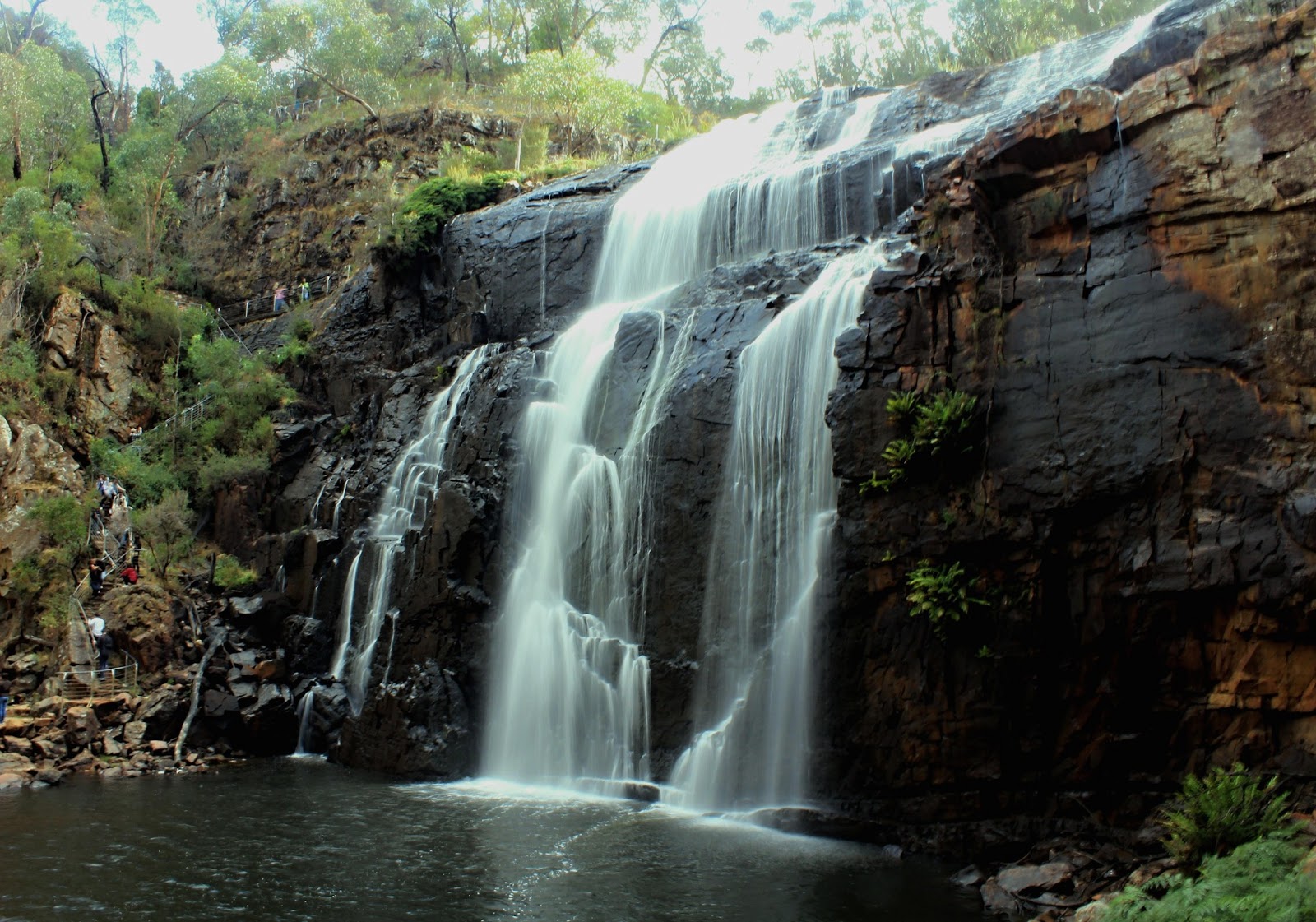
Mackenzie Falls, Grampians National Park, Victoria